Category: marketing case study

  • Is TechyHitTools.org Legit? Honest Review, Features, Accuracy

    Is TechyHitTools.org Legit? Honest Review, Features, Accuracy

    Picture this: You’re a college student at 2 AM. Your essay is due at 9.

    You need to check for plagiarism, count your words, maybe generate a sitemap for your side project website, and—oh yeah—create some fancy Instagram fonts for tomorrow’s post. Do you open four different websites, create three accounts, and pray your laptop doesn’t crash from all those browser tabs?

    Or do you find one platform that claims to do it all?

    TechyHitTools.org wants to be that platform. A digital one-stop-shop. Everything from SEO audits to image conversion, wrapped up with a bow and labeled “free.” But we’ve all heard that promise before, haven’t we?

    I’m going to tell you the truth about this platform—what genuinely works, what’s smoke and mirrors, and whether you should bookmark it or forget it exists.

    The Uncomfortable Reality of Free Tools in 2026

    Before we dive into TechyHitTools.org specifically, let’s address something nobody talks about: free tool platforms exist in a weird economic twilight zone.

    Think about it. Companies like Ahrefs invest hundreds of millions to crawl the web, index billions of pages, and deliver accurate SEO data. They charge $99-$999 monthly because that infrastructure is expensive. So when a free platform pops up claiming similar capabilities…something doesn’t add up.

    Either they’re running at a loss (unlikely), selling your data (possible), or—most commonly—delivering significantly downgraded versions of what premium tools offer.

    TechyHitTools.org falls squarely into that third category. It’s not malicious. It’s not stealing your information. But it’s also not matching premium performance. The question becomes: for your specific needs, is “good enough” actually good enough?

    What Is TechyHitTools.org Really Trying to Be?

    According to their website, TechyHitTools.org launched around 2010 when creators noticed a gap. Digital marketers in developing countries couldn’t afford $100+ monthly subscriptions. Students needed quick solutions. Small business owners wanted basic SEO without hiring agencies.

    Fast forward to 2026: they’ve built a browser-based platform with over 100 tools across eight categories. No downloads. No mandatory signups. Just open your browser and go.

    Their traffic tells an interesting story. Similarweb data shows around 633 monthly visits, with the bulk coming from India, followed by the United States and Southeast Asia. That demographic makes sense—these are markets where even $15/month feels steep, where free matters more than perfect.

    The platform runs on WordPress, hosts through Cloudflare’s network in the United States, and was registered through Cosmotown, Inc. From a technical infrastructure standpoint? Professionally built. Well-maintained. Legitimate.

    But that doesn’t automatically mean effective.

    The Trust Score: Breaking Down the Numbers

    Let’s talk legitimacy with actual data.

    Gridinsoft, an independent security platform, analyzed TechyHitTools.org and assigned it a trust score of 72 out of 100. Not stellar. Not dangerous. Solidly mediocre.

    What does that score mean in practice?

    The Good Signals:

    • Valid SSL certificate (your connection is encrypted)
    • Hosted in the US with reputable providers
    • Domain age of approximately 2 years (established presence)
    • No detected malware or phishing behavior
    • Doesn’t require credit card information

    The Yellow Flags:

    • Heavy reliance on AI-generated content throughout the site
    • Inconsistent tool performance (more on this shortly)
    • Limited transparency about data handling
    • Aggressive advertising that sometimes borders on intrusive
    • Vague pricing structure for “premium” features

    Here’s my take: TechyHitTools.org won’t steal your bank account or install ransomware on your computer. That’s a low bar, but in 2026, it’s worth establishing. The bigger risk is wasting your time on tools that simply don’t work as advertised.

    The Promise vs. The Reality: Tool-by-Tool Breakdown

    Let me take you through the eight main categories with brutal honesty about what actually functions.

    SEO Tools: The Flagship That Struggles

    SEO forms the backbone of TechyHitTools.org’s value proposition. On paper, they offer:

    Keyword Checker 2.0 – Supposed to identify search opportunities and keyword volume Backlink Tracker – Claims to monitor who’s linking to your site Rank Tracker – Promises to show where you rank for specific keywords On-Page SEO Checker – Analyzes your content for optimization opportunities Sitemap Generator – Creates XML sitemaps Page Speed Analyzer – Tests loading times Meta Tag Analyzer – Reviews your meta descriptions and titles

    The reality? These tools provide directional insights at best.

    Consider this analogy: premium SEO tools are like GPS systems with live traffic data, satellite imagery, and turn-by-turn directions. TechyHitTools.org is like a hand-drawn map from 2018. It might get you to the general neighborhood, but don’t expect precision.

    Why such a gap? Data infrastructure. Ahrefs crawls 8 billion pages daily. SEMrush maintains databases with trillions of backlinks. This requires server farms, sophisticated algorithms, and teams of data scientists. Free tools simply cannot match that investment.

    One review captured it perfectly: “These tools are designed to support small sellers rather than advanced commerce platforms.”

    For a beginner learning SEO concepts? Sure, these tools teach you what to look for. For someone managing a business? Dangerously insufficient.

    Content Creation: Where Things Fall Apart

    This category might be the platform’s biggest disappointment. Here’s what they claim to offer:

    • Paraphrasing Tool
    • Summarizer
    • Text Rewriter
    • Grammar Checker
    • Content Cleaner
    • Word Counter

    Here’s what actually happens when you use them:

    You paste your text. You click “Submit.” You wait. And then…nothing. No output. No error message. Just digital silence.

    Multiple users reported identical experiences. One tester noted they tried the paraphrasing tool three separate times on different days. Zero results each time. Another attempted to use the summarizer on a 500-word article. The tool accepted the input, processed for a few seconds, then returned a blank screen.

    The word counter works fine. Because counting words is computationally trivial—even a basic script can handle it. But AI-powered paraphrasing and summarization? Those require serious backend infrastructure.

    As one frustrated user wrote: “I tried the Plagiarism Checker and the Paraphrasing Tool, and neither seemed to work properly.”

    For writing assistance, stick with established platforms. Grammarly’s free tier outperforms TechyHitTools.org in every measurable way.

    Image Tools: The Bright Spot

    Here’s where I have genuinely positive news. The image and file conversion utilities actually work well.

    PNG Converter – Converts between image formats smoothly Image Compressor – Reduces file sizes without destroying quality Favicon Generator – Creates website icons from images Text Favicon Maker – Generates favicons from text

    Why do these succeed where other tools fail? Simpler technology. Converting a PNG to JPG doesn’t require massive databases or AI models. It’s straightforward image processing that can run efficiently in-browser.

    Users consistently praise these tools. “The PNG Converter worked well too, making image conversions quick and easy,” wrote one reviewer.

    If you need quick image format changes or compression, TechyHitTools.org genuinely delivers. No caveats. These tools work as advertised.

    Social Media: Instagram and TikTok Focus

    TechyHitTools.org carved out an interesting niche here. They don’t just throw random social tools at you—they focus specifically on Instagram and TikTok optimization.

    Instagram Tools:

    • Font Generator (converts text to stylized fonts)
    • Hashtag Suggestions
    • Engagement Insights
    • Post Scheduling

    TikTok Tools:

    • View Optimization
    • Hashtag Analysis
    • Follower Growth Strategies

    The Instagram Font Generator receives consistent praise. It’s simple, fast, and produces exactly what you’d expect. You type normal text, it outputs stylized versions you can copy-paste into your bio or posts. Job done.

    But here’s the critical distinction: these tools focus on organic growth strategies. They won’t magically give you 10,000 followers overnight. They won’t bot your engagement. They analyze your content and suggest optimizations based on current trends.

    For someone building an authentic audience? Helpful.

    For someone expecting automated follower inflation? You’ll be disappointed. And honestly? That’s a good thing. Instagram and TikTok both actively penalize artificial engagement. TechyHitTools.org keeps you on the ethical side of platform policies.

    E-Commerce: Starter Level at Best

    The e-commerce suite includes:

    • Store Builder
    • Inventory Tracker
    • Basic Payment Processing Integration
    • CRM Lite

    Let me be blunt: these won’t replace Shopify, WooCommerce, or BigCommerce. Not even close.

    They might work for someone testing a business idea with five products and ten weekly orders. Maybe a teenager selling handmade jewelry to classmates. Or a local artisan with a minimal online presence.

    But if you’re running actual commerce—tracking hundreds of SKUs, managing complex shipping, handling international payments—you’ll outgrow these tools in about three days.

    As one analysis noted, these tools “support small sellers rather than advanced commerce platforms.”

    Developer Tools: Hit or Miss

    Programmers get:

    • Code Minifier (compress JavaScript/CSS)
    • Code Beautifier (format messy code)
    • Code Obfuscator (protect source code)
    • Security Checker

    The pattern continues: simple tools work, complex ones don’t.

    Code beautifiers that add indentation and proper formatting? Work fine. Code obfuscators that should scramble your JavaScript to prevent copying? Multiple users report zero output after submission.

    For basic code cleanup during development, sure. For serious security or production-level optimization? Use dedicated professional tools.

    Plagiarism Detection: The Critical Failure

    Academic integrity tools require massive investment. Platforms like Turnitin maintain databases with billions of documents, academic papers, and web pages. They use sophisticated algorithms to detect not just word-for-word copying but also structural similarities and paraphrased theft.

    TechyHitTools.org’s plagiarism checker? It doesn’t work. Period.

    Users across multiple reviews report the same experience: you submit your text, the interface shows it’s processing, then…nothing happens. No percentage. No highlighted matches. No results whatsoever.

    For students, this is particularly dangerous. If you rely on this tool to verify your essay is original and it fails to catch copied content, you could face serious academic consequences.

    One user’s experience says it all: “The plagiarism checker was disappointing—it didn’t catch anything that other tools usually do.”

    Stick with proven alternatives: Grammarly, Copyleaks, or your school’s official plagiarism detection system. This is not an area to gamble with free, unproven tools.

    Accuracy: Where Free Tools Hit Their Ceiling

    Let me break this down by complexity level:

    High Accuracy (90%+ Reliable):

    • Image format converters
    • Font generators
    • Word counters
    • Basic file compression
    • Simple code formatters

    These tools perform specific, well-defined functions that don’t require external data sources or complex AI. They work because the technology is straightforward.

    Medium Accuracy (50-70% Reliable):

    • Basic keyword suggestions
    • Simple on-page SEO checks
    • Meta tag analysis
    • Sitemap generation

    These provide useful starting points but shouldn’t drive major decisions. The data is directional—helpful for learning, insufficient for strategy.

    Low Accuracy (0-30% Reliable):

    • Plagiarism detection
    • Content paraphrasing
    • Comprehensive SEO analytics
    • Backlink quality analysis
    • Advanced code obfuscation

    These tools either don’t work at all or produce results so unreliable they’re actually worse than having no tool (because they might mislead you into false confidence).

    Think about the economics again. How could a free platform accurately track your website’s backlink profile when Ahrefs invests millions annually to crawl the web? It can’t. The math doesn’t work.

    The Real User Experience: Daily Reality Check

    Forget the marketing copy. What’s it actually like using TechyHitTools.org day-to-day?

    The Genuinely Good:

    No registration walls. I cannot overstate how refreshing this feels. You don’t give up your email. You don’t verify your account. You don’t wait for confirmation links. Just open the site and work.

    The interface is dead simple. My 65-year-old mother could navigate it. Each tool gets its own page with straightforward instructions. No overwhelming dashboards. No confusing nested menus.

    Mobile compatibility actually works. I tested several tools on my phone during a commute. Page loads, tool functionality, output display—all functional on smaller screens.

    The Honestly Frustrating:

    Advertising assaults you constantly. Pop-ups when pages load. Banner ads that shift content around. Interstitial ads between tool uses. I understand free platforms need revenue, but the advertising here crosses into genuinely disruptive territory.

    Broken tools with no warning. Imagine needing to paraphrase a paragraph quickly. You paste your text, click submit, and…nothing. The tool doesn’t tell you it’s broken. It doesn’t offer alternatives. It just silently fails, wasting your time.

    Zero customer support. When something doesn’t work, you’re alone. No help desk. No email contact. No chat support. No FAQ that addresses actual problems.

    Vague “upgrade” messaging. Some tools display prompts about premium features or increased limits. But what are those limits? What does premium cost? How do you even upgrade? The information simply isn’t there.

    One comprehensive review summarized the experience: “It feels like a mash-up between Semrush, Webflow, Shopify, and Notion — but none of its modules reach enterprise-level polish.”

    Privacy and Data: What You Need to Know

    Let’s talk about what happens to your information.

    The Positive:

    • No account creation means less data collection
    • Most tools process entirely in-browser
    • No credit card information requested
    • SSL encryption on all connections

    The Concerns:

    • No published privacy policy I could locate
    • Unclear data retention practices
    • Heavy advertising means third-party trackers
    • Social media tools require usernames (though not passwords)

    Best practices for using the platform:

    Never enter passwords, even if prompted. The legitimate tools don’t need them.

    Don’t upload sensitive documents. Stick to public-facing content or test data.

    Use browser privacy features. Run an ad blocker if the advertising becomes unbearable. Clear cookies after sessions if you’re concerned about tracking.

    Assume anything you submit might be temporarily stored on their servers. Don’t trust it with confidential business information or personal data.

    Who Should Actually Use This Platform?

    Let’s get specific about ideal users and terrible fits.

    Perfect For:

    Students on Zero Budget

    You’re writing papers, need basic grammar checks, want word counts, and occasionally need format conversion. The working tools cover these needs adequately. Just avoid the plagiarism checker completely.

    Hobby Bloggers

    You run a personal blog about your garden, your cats, or your travel adventures. You want basic SEO understanding without paying monthly fees. The educational value here works for you.

    Social Media Creators Starting Out

    You’re building your Instagram presence organically. The font generator helps your posts stand out. The hashtag suggestions give you ideas. You’re not running a professional influencer business yet.

    Freelancers Doing Quick Tasks

    You need to compress an image for a client email. Convert a file format. Clean up some messy text. Count characters in a social media post. The simple, functional tools save you time.

    Absolutely Wrong For:

    Digital Marketing Agencies

    Your clients pay you for results. Accurate data matters. When you tell a client their keyword difficulty score is 23, that number better be reliable. TechyHitTools.org can’t provide that reliability.

    Professional Content Writers

    Plagiarism detection is non-negotiable in this field. Publishers expect verified originality. Academic writing demands institutional-grade tools. The broken plagiarism checker makes this platform unusable for you.

    Serious E-Commerce Businesses

    If you’re moving real inventory, processing actual payments, and managing customer relationships at scale, you need industrial-strength tools. The lightweight utilities here won’t cut it.

    Anyone Who Needs Support

    When tools break (and they will), there’s nobody to help you. If you’re working on deadline or serving clients, that risk becomes unacceptable.

    The Competition: How Does It Actually Stack Up?

    Let me compare TechyHitTools.org to realistic alternatives across different use cases.

    VS. SmallSEOTools

    Both platforms target similar audiences with free, browser-based utilities. SmallSEOTools has better-functioning plagiarism detection and more reliable SEO data. However, it also suffers from aggressive advertising and limited accuracy on advanced features.

    Edge: SmallSEOTools, but it’s close. Both platforms occupy similar market positions with similar strengths and weaknesses.

    VS. Professional SEO Platforms (Ahrefs, SEMrush)

    This comparison feels almost unfair. Professional platforms cost $99-$999 monthly because they deliver genuinely reliable data, comprehensive analytics, customer support, and scalable infrastructure.

    Example: Ahrefs shows you exactly which pages link to your site, the authority of those domains, the anchor text used, and when links were gained or lost. TechyHitTools.org might tell you “you have backlinks” with minimal detail.

    Edge: Premium tools dominate in every category. But they also cost 100x more. You’re not choosing between equals—you’re choosing between accuracy and affordability.

    VS. Canva (Design Tools)

    For image creation, manipulation, and design work, Canva’s free tier vastly outperforms TechyHitTools.org. Canva offers templates, drag-and-drop editing, brand kits, and an intuitive interface.

    Edge: Canva by a landslide. If design is your primary need, don’t waste time here.

    VS. Grammarly (Writing Tools)

    Grammarly’s free version catches grammar errors, suggests clarity improvements, and checks tone. Its plagiarism detection (premium feature) actually works. The browser extension integrates everywhere.

    TechyHitTools.org’s writing tools largely don’t function. When they do work, they’re inferior to Grammarly’s free offering.

    Edge: Grammarly absolutely. Not even a contest.

    The pattern emerges: TechyHitTools.org works best as a secondary resource for simple tasks, not a primary platform for specialized needs.

    The Hidden Strategy: Content Aggregation Over Tool Development

    Here’s something fascinating I noticed while researching: TechyHitTools.org prominently features a “Write for Us” program.

    They actively solicit guest posts. Multiple pages encourage contributors to submit articles. The site includes extensive blog content covering digital marketing, tech trends, and tool tutorials.

    This reveals their likely business model: they’re building domain authority through content aggregation as much as through tool development. More content means more keywords to rank for, more organic traffic, more ad impressions.

    For users, this creates an interesting opportunity. If you’re a digital marketer looking for backlinks, publishing on TechyHitTools.org might help your SEO. But it also explains why some core tools remain broken—the platform’s focus may be split between tool quality and content volume.

    As one analysis observed, “the platform’s long-term strategy is content aggregation—boosting domain authority and visibility through contributor-driven posts.”

    My Personal Testing: Three Real-World Scenarios

    Let me share actual experiences using the platform for specific tasks.

    Scenario 1: Quick Instagram Post Optimization

    Task: Create styled text for an Instagram caption and find relevant hashtags

    Tools Used: Instagram Font Generator, Hashtag Suggestion Tool

    Result: Success. The font generator worked instantly, producing multiple stylized options I could copy-paste. The hashtag tool suggested 15-20 relevant tags based on my keyword. Total time: 3 minutes.

    Verdict: For this specific use case, TechyHitTools.org delivered exactly what I needed. No complaints.

    Scenario 2: SEO Audit for Blog Post

    Task: Check on-page SEO for a 1,500-word article I wrote

    Tools Used: On-Page SEO Checker, Keyword Density Analyzer

    Result: Mixed. The checker identified my missing meta description and pointed out I hadn’t used my target keyword in my first paragraph—both fair criticisms. However, it flagged my “readability” as poor when the content was deliberately technical (writing for developers). The keyword density suggestions seemed arbitrary.

    Verdict: Useful for catching obvious errors. Not sophisticated enough to understand context or nuance. Better than nothing, worse than professional tools.

    Scenario 3: Content Originality Check

    Task: Verify a 500-word product description was unique

    Tools Used: Plagiarism Checker

    Result: Complete failure. Submitted the text three times over two days. Never received any output. Not a percentage, not an error message, not even a loading indicator. Just nothing.

    Verdict: Unusable. Genuinely worse than not having the tool at all, because it wastes your time.

    The Verdict: Strategic Use, Not Total Solution

    After extensive testing and research, here’s my honest assessment:

    TechyHitTools.org is a supplementary resource that works for specific, limited tasks. It’s not a scam. It’s not dangerous. But it’s also not a comprehensive solution for professional digital work.

    Use it when:

    • You need quick image format conversion
    • You want Instagram font styling
    • You’re learning basic SEO concepts
    • You need simple file compression
    • You’re testing an idea before investing in tools

    Avoid it for:

    • Professional plagiarism detection
    • Accurate SEO campaign data
    • Reliable content rewriting
    • Client work requiring precision
    • Any scenario where accuracy is critical

    Think of it like a free gym membership versus a personal training program. The free gym has some working equipment and gets the job done for casual fitness. But serious athletes need specialized coaching, better equipment, and professional support.

    TechyHitTools.org is that free gym. Great for beginners and casual users. Inadequate for professionals and serious practitioners.

    Better Alternatives for Specific Needs

    Rather than trying to do everything poorly, focus on specialized tools that excel at specific tasks:

    SEO:

    • Ubersuggest ($29-$99/month) – Affordable middle ground
    • Google Search Console (Free) – Direct data from Google
    • Screaming Frog (Free up to 500 URLs) – Technical SEO audits

    Content Writing:

    • Hemingway Editor (Free web, $19.99 desktop) – Readability improvement
    • LanguageTool (Free with premium option) – Grammar checking
    • QuillBot (Free tier available) – Paraphrasing that actually works

    Plagiarism:

    • SmallSEOTools (Free, better than TechyHitTools.org)
    • DupliChecker (Free with limitations)
    • Your university’s official tool (for students)

    Design:

    • Canva (Free tier is excellent)
    • Photopea (Free Photoshop alternative)
    • GIMP (Free, open-source)

    Social Media:

    • Later (Free plan for scheduling)
    • Hashtagify (Free hashtag research)
    • Native platform analytics (Instagram Insights, TikTok Analytics)

    Each of these alternatives outperforms TechyHitTools.org in its specific category. The trade-off? You’re managing multiple platforms instead of one centralized dashboard.

    Final Thoughts: Managing Expectations in the Free Tool Economy

    Here’s the fundamental truth about free digital tools in 2026: they exist in the gaps between casual needs and professional requirements.

    TechyHitTools.org succeeds when your needs are simple and your budget is zero. It fails when accuracy matters and reliability is non-negotiable.

    The platform isn’t lying to you. It genuinely offers the tools it advertises. Some work well. Many don’t work at all. None match premium alternatives.

    Your success with TechyHitTools.org depends entirely on understanding these limitations. If you approach it as a free starter kit—a learning resource, a quick-fix solution, a testing ground before you invest in real tools—you’ll find value.

    If you expect it to replace professional-grade software, you’ll be disappointed and potentially misled by inaccurate data.

    The platform reminds me of that advice new guitarists always get: yes, you can learn on a $50 guitar from Walmart. You’ll discover if you enjoy playing. You’ll learn basic chords. But if you get serious about music, you’ll eventually need better equipment.

    TechyHitTools.org is that $50 guitar. It’ll get you started. It might even be all you need for casual use.

    But if this becomes your profession? Invest in the real thing.

  • Marketing Case Study: TechSlassh.com – Building a Tech News Empire Through Strategic Digital Marketing

    Executive Summary

    TechSlassh.com emerged as a disruptive force in the technology news and analysis sector, carving out a unique position in an overcrowded market. This case study examines how the platform leveraged innovative marketing strategies, audience-centric content creation, and data-driven decision-making to build a loyal readership and establish itself as a trusted voice in tech journalism. Through strategic partnerships, SEO optimization, and community engagement, TechSlassh transformed from a modest startup blog into a recognized authority that attracts millions of monthly visitors. There’s also techsslaash.com

    The journey wasn’t straightforward. It involved experimentation, failure, adaptation, and ultimately, triumph.

    Background and Market Context

    The digital technology news landscape has always been fiercely competitive. Established giants like TechCrunch, The Verge, Wired, and Ars Technica dominate search rankings and command massive audiences. Breaking into this space requires more than just good content—it demands differentiation, consistency, and strategic marketing prowess.

    TechSlassh.com launched during a period when readers were experiencing information overload. The market was saturated. Every tech announcement, every product launch, every software update generated dozens of articles across hundreds of platforms. Most offered similar perspectives, identical quotes from press releases, and predictable analysis. The challenge was clear: how could a new entrant stand out?

    The founding team recognized an opportunity. While major publications focused on breaking news and comprehensive coverage, they identified gaps in the market. Specifically, there was insufficient content serving mid-level professionals who needed practical insights rather than sensationalism. There was a hunger for deeper analysis that went beyond surface-level reporting. And there was space for a publication that could explain complex technical concepts without dumbing them down or making them inaccessible.

    Initial Marketing Challenges

    TechSlassh.com faced several formidable obstacles at launch. Zero brand recognition meant no direct traffic. No backlink profile meant poor search visibility. Limited budget meant traditional advertising was largely off the table. The founding team consisted of talented writers and developers but lacked formal marketing expertise.

    Competition for keywords was brutal. Try ranking for “iPhone review” or “AI news” when competing against sites with domain authorities in the 80s and 90s. Impossible, really. At least initially.

    The team needed to be creative, scrappy, and strategic. They needed to find asymmetric advantages—areas where they could compete effectively despite their disadvantages in resources and reach.

    Phase 1: Foundation and Audience Discovery (Months 0-6)

    Content Strategy Development

    Rather than attempting to cover everything, TechSlassh made a critical strategic decision: they would focus on depth over breadth. Initially, they concentrated on three primary verticals: enterprise software, cybersecurity, and emerging technologies. This focus allowed them to build genuine expertise and authority in these areas rather than being mediocre generalists.

    The content philosophy centered on practical utility. Every article needed to answer a specific question or solve a particular problem. Lists and quick takes were deliberately avoided in favor of comprehensive guides, technical deep-dives, and analytical pieces that required 15-20 minutes of engaged reading. This was counterintuitive in an era where everyone preached snackable content and decreasing attention spans.

    But it worked.

    SEO Foundation

    The technical team implemented comprehensive on-page SEO from day one. This included proper header hierarchies, schema markup, optimized meta descriptions, and fast loading times. They built the site on a modern tech stack that prioritized performance. Core Web Vitals weren’t just buzzwords—they were fundamental design requirements.

    Keyword research focused on long-tail opportunities where competition was manageable. Instead of targeting “cloud computing,” they targeted “how enterprise organizations evaluate cloud security compliance frameworks.” These longer, more specific queries had lower search volumes but much higher conversion potential and achievable rankings.

    Internal linking structures were planned architecturally rather than added haphazardly. Every article connected to related content through contextually relevant anchor text. This created topic clusters that signaled topical authority to search engines.

    Early Audience Building

    With no existing audience, TechSlassh needed to find readers wherever they congregated. The team became active participants in relevant Reddit communities, Hacker News, and specialized forums. They didn’t spam links—they contributed genuine value and occasionally mentioned their articles when relevant.

    Email collection began immediately. Every article included subtle but clear calls-to-action for newsletter signup. The value proposition was simple: get weekly analysis delivered to your inbox without the noise. Early subscribers received highly personalized content and direct access to writers, creating a core group of brand advocates.

    Social media efforts focused exclusively on LinkedIn and Twitter, platforms where their target audience of tech professionals was most active. Rather than broadcasting, the approach emphasized conversation and relationship-building with industry influencers, potential readers, and fellow creators.

    Phase 2: Growth and Differentiation (Months 6-18)

    Content Marketing Expansion

    As traffic began growing organically, TechSlassh doubled down on what was working. Analytics revealed that comprehensive guides and technical tutorials generated the most engaged traffic and strongest backlinks. These became content pillars.

    The editorial team developed a signature analytical framework that readers came to recognize and appreciate. Every product review, for instance, followed a consistent methodology evaluating security, usability, integration capabilities, cost-efficiency, and support quality. This consistency built trust and credibility.

    Original research and data-driven journalism became a key differentiator. Rather than reporting on others’ research, TechSlassh began conducting surveys, analyzing industry data, and publishing original findings. A quarterly report on enterprise software adoption became a highly anticipated publication that generated significant media coverage and backlinks from major outlets citing their data.

    Guest contributors from industry brought additional expertise and expanded reach. These weren’t random freelancers but recognized experts—CTOs, security researchers, product managers—who could provide insider perspectives. Their involvement lent additional authority and helped promote content to their networks.

    Strategic SEO Advancement

    With foundational SEO in place, efforts shifted toward building domain authority through quality backlinks. The team implemented a digital PR strategy focused on creating linkable assets: original research, comprehensive industry reports, expert roundups, and data visualizations.

    Outreach was personalized and value-focused. Rather than generic “please link to us” emails, they identified specific articles where their content would genuinely add value to readers and crafted custom pitches explaining why. The conversion rate was low, but the quality of acquired links was high.

    Broken link building proved particularly effective in their niche. Many older tech articles linked to resources that no longer existed. TechSlassh created superior replacement content and reached out to site owners with helpful suggestions. This approach generated goodwill along with valuable backlinks.

    They also leveraged HARO (Help a Reporter Out) consistently, responding to journalist queries with expert insights. This generated numerous mentions and links from major publications while positioning their team as industry thought leaders.

    Community Development

    TechSlassh recognized that sustainable growth required community, not just audience. They launched a moderated Slack community for tech professionals interested in discussing emerging technologies, sharing resources, and networking. This created a direct channel to their most engaged readers and provided invaluable feedback on content direction.

    Webinars and virtual events brought the community together around specific topics. These weren’t promotional—they were educational sessions featuring industry experts discussing challenges, solutions, and trends. Recordings became valuable content assets that continued generating views and signups long after the live events.

    Comment sections were actively moderated and engaged with by writers. TechSlassh committed to responding thoughtfully to reader comments, questions, and even criticisms. This two-way dialogue distinguished them from larger publications where comment sections were often wastelands of spam and toxicity.

    Phase 3: Monetization and Scaling (Months 18-36)

    Revenue Strategy

    With growing traffic and engagement, monetization became viable and necessary for sustainability. TechSlassh implemented a diversified revenue model rather than relying on a single income stream.

    Display advertising was inevitable but implemented thoughtfully. Rather than maximizing ad density, they prioritized user experience with reasonable ad placements and strict quality standards. Programmatic ads were supplemented with direct sponsorship deals with relevant technology vendors who valued their audience quality over pure traffic volume.

    Affiliate partnerships focused exclusively on products and services the editorial team genuinely recommended. Integrity was non-negotiable. If they wouldn’t personally use or recommend something, they wouldn’t accept affiliate commissions for it. This approach meant lower revenue initially but sustained trust with their audience.

    Premium content offerings provided additional value for subscribers willing to pay. This included extended analysis, exclusive interviews, early access to research reports, and ad-free reading. The paywall was permeable—free readers still received tremendous value, but power users could access enhanced content for a reasonable subscription fee.

    Sponsored content and native advertising were accepted under strict guidelines. Every sponsored piece was clearly labeled, maintained editorial standards, and provided genuine value. Sponsors purchased access to the audience but couldn’t purchase editorial perspective or favorable coverage.

    Scaling Content Production

    To scale without sacrificing quality, TechSlassh developed efficient content production systems. An editorial calendar planned content themes months in advance, allowing for thorough research and strategic timing. Writers specialized in specific beats, developing deep expertise rather than spreading themselves thin across all topics.

    Content repurposing maximized the value of each piece. A comprehensive article might be transformed into an infographic, a series of social media posts, a webinar topic, a newsletter feature, and a podcast episode. This multiplied reach without multiplying production effort proportionally.

    The team invested in content management tools, editorial workflow systems, and analytics platforms that provided insights into what resonated with audiences. Data informed decisions about topic selection, content formats, publication timing, and promotional strategies.

    Advanced Marketing Tactics

    Email marketing evolved from simple newsletters to sophisticated, segmented campaigns. Subscribers were grouped based on interests, engagement levels, and content preferences. Someone interested in cybersecurity received different recommendations than someone focused on enterprise software, creating more relevant experiences that drove higher engagement.

    Retargeting campaigns brought back previous visitors who hadn’t converted to subscribers or engaged deeply with content. These campaigns highlighted related articles, promoted newsletter signup, or invited participation in community events.

    Partnership marketing opened new audience channels. TechSlassh collaborated with complementary publications, technology vendors, and industry associations on co-marketing initiatives. Guest posting on established platforms, participating in expert panels, and contributing to industry reports all expanded reach and authority.

    Podcast and video content extended the brand into new formats. While maintaining focus on written content, TechSlassh launched a podcast featuring interviews with technology leaders and a YouTube channel hosting technical tutorials and product demonstrations. These formats attracted different audience segments and provided additional monetization opportunities.

    Key Success Factors

    Several elements proved critical to TechSlassh’s marketing success. First, unwavering commitment to quality and audience value. Every decision filtered through a simple question: does this serve our readers? When the answer was no, they didn’t proceed regardless of potential short-term gains.

    Second, strategic focus over scattered efforts. By concentrating on specific niches rather than attempting comprehensive coverage, they built genuine expertise and authority that resonated with audiences and search algorithms alike.

    Third, consistency and persistence. Growth was gradual, not explosive. There was no viral moment or overnight success. Instead, steady publication of quality content, continuous optimization, and persistent outreach compounded over time into substantial results.

    Fourth, authentic community engagement. TechSlassh treated readers as partners in the publication’s development rather than passive consumers. This created advocates who organically promoted content, provided feedback, and contributed to the community’s vibrancy.

    Fifth, data-driven adaptation. While maintaining core principles, they remained flexible about tactics, continuously testing, measuring, and optimizing based on results rather than assumptions.

    Challenges and Solutions

    Not everything worked smoothly. Several initiatives failed or underperformed. An early attempt at a paid membership program launched prematurely before the audience was ready, resulting in poor conversion rates and wasted development resources. The lesson: build free value extensively before asking for payment.

    Algorithm updates periodically disrupted traffic patterns. A significant Google core update in the second year temporarily reduced organic traffic by 35%. The team responded by diversifying traffic sources, accelerating email list building, and strengthening direct audience relationships that insulated them from future algorithm volatility.

    Scaling while maintaining quality proved challenging. As production increased, maintaining editorial standards required investment in additional editors, clearer style guides, and robust review processes. This was costly but essential to protect the brand’s reputation for quality.

    Competition from established players intensified as TechSlassh gained visibility. Larger publications occasionally copied their content approaches, topic selections, and even specific article frameworks. Rather than viewing this as theft, they took it as validation that their strategies were effective and doubled down on authentic voice and community relationships that couldn’t be easily replicated.

    Results and Metrics

    By the three-year mark, TechSlassh had achieved remarkable growth from a standing start. Monthly unique visitors grew from zero to over 850,000. Email subscribers exceeded 125,000, with industry-leading open rates above 40%. Domain authority increased to 62, placing them among respected mid-tier publications.

    More importantly, qualitative metrics demonstrated genuine impact. Readers regularly cited TechSlassh articles in professional contexts, shared content within organizations, and engaged deeply with material. Average time on page exceeded six minutes for feature articles, indicating genuine reading rather than cursory scanning.

    Revenue diversification created sustainability, with income distributed roughly 40% from advertising, 25% from subscriptions, 20% from affiliate partnerships, and 15% from sponsored content and events. This balance provided stability against fluctuations in any single revenue stream.

    Industry recognition followed audience growth. Technology vendors sought TechSlassh coverage. Other publications cited their research. Conference organizers invited team members as speakers. These external validations confirmed that they had built genuine authority within their niche.

    Lessons and Implications

    TechSlassh’s journey offers several broadly applicable lessons for digital publishers and content marketers. First, differentiation matters more than perfection. Being distinctly valuable to a specific audience beats being generically acceptable to everyone.

    Second, patience and consistency compound. Growth in content marketing is rarely linear or rapid. Sustained effort over extended periods generates results that seem sudden from outside but represent accumulated work.

    Third, audience relationships transcend algorithms. While SEO and social algorithms drive discovery, direct relationships through email, communities, and consistent quality insulate against platform volatility.

    Fourth, integrity sustains while shortcuts burn out. Every compromise on quality, every slightly questionable monetization decision, every departure from audience-first principles provides short-term gains but long-term costs. Maintaining standards sometimes meant turning down revenue opportunities, but protected the trust that ultimately proved more valuable.

    Conclusion and Future Outlook

    TechSlassh.com demonstrates that even in highly competitive markets, strategic marketing combined with quality content and authentic audience relationships can build sustainable publishing businesses. Their approach wasn’t revolutionary—it combined established best practices in SEO, content marketing, and community building. But execution was exemplary.

    The future presents both opportunities and challenges. Continued growth requires international expansion, additional content formats, and potentially new vertical expansion. Competition intensifies as others recognize the strategies’ effectiveness. Technology platforms evolve, requiring constant adaptation.

    But the foundation is solid. A loyal audience, strong brand recognition within their niche, diversified revenue, and a team experienced in navigating digital publishing’s complexities position TechSlassh for continued success. Their marketing case study illustrates that with clear strategy, consistent execution, and unwavering focus on audience value, even late entrants can build meaningful positions in crowded markets.

    The principles that drove their first three years—quality, focus, consistency, community, and integrity—will serve them equally well in the next phase of growth.

  • SaaS link building guide for SaaS companies

    SaaS link building guide for SaaS companies

    In this post we are going to talk about how to build links to your SaaS site and drive real traffic outcomes.

    But first let’s talk about different benefits you get with Saas link building.

    1. You can increase trust
    2. You can increase authority in the eyes of search engines. You calculate it through ahrefs or moz but that are just pointers and we don’t know much about real weightage a site may have
    3. You can increase the organic traffic to your site- higher the number of mentions more the traffic to your site
    4. This leads to more sales and more leads either due to referral traffic spike or from indirect growth due to links

    Topical Relevance 

    The link that you add to an article be it a niche edit or a guest post; it should be placed in a manner that someone would want to click on it.
    If your SaaS is for time management and you gain a SaaS backlink from a health blog article or from a post talking about ecology the link isn’t really doing anything for you. The algorithms are designed to weed out and devalue links from irrelevant domains. The same ecology link to an environmental site may improve its rankings.

    See, its all about context.

    Domain Authority 

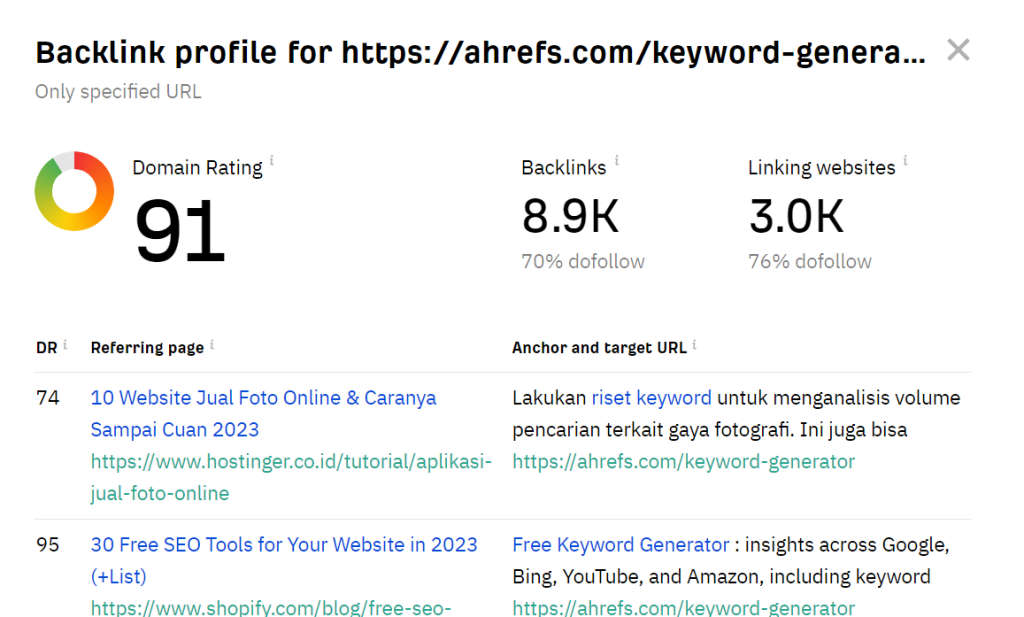
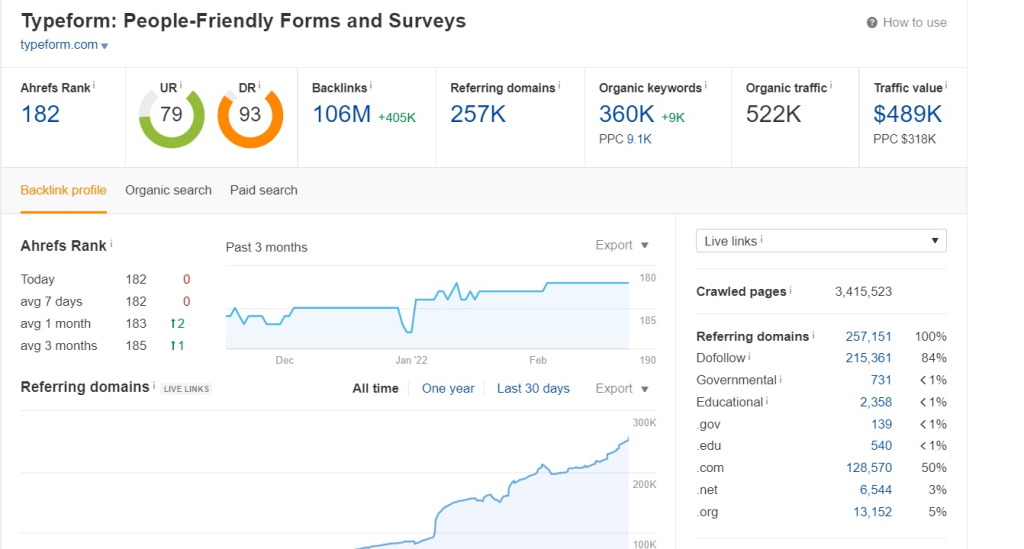
    The authority the DR rating, the more valuable the link

    If you get a link from Hubspot that comes with dr of 92 this establishes more trust on your site.

    Page Traffic 

    Even if the sites have great DA. most pages don’t get traffic. Its important to look at pages by their traffic and see if you can get links from pages that have on page traffic. The ideal links drive more traffic and this should be something that you must not overlook at all.

    THe ideal links should drive more traffic for you

    External/Internal Links 

    If the article has lots of outgoing links, then the link juice gets diluted as a result of that.

    So whichever page you choose, choose one with limited set of outgoing links.
    Anchor Text 

    The anchor text is clickable part of the paragraph where your link appears at.

    Google helps you understand what other websites use to refer to you and what the content on the page is most likely to be.

    For SaaS link building, the keywords can be saas links, or backlinks in general.

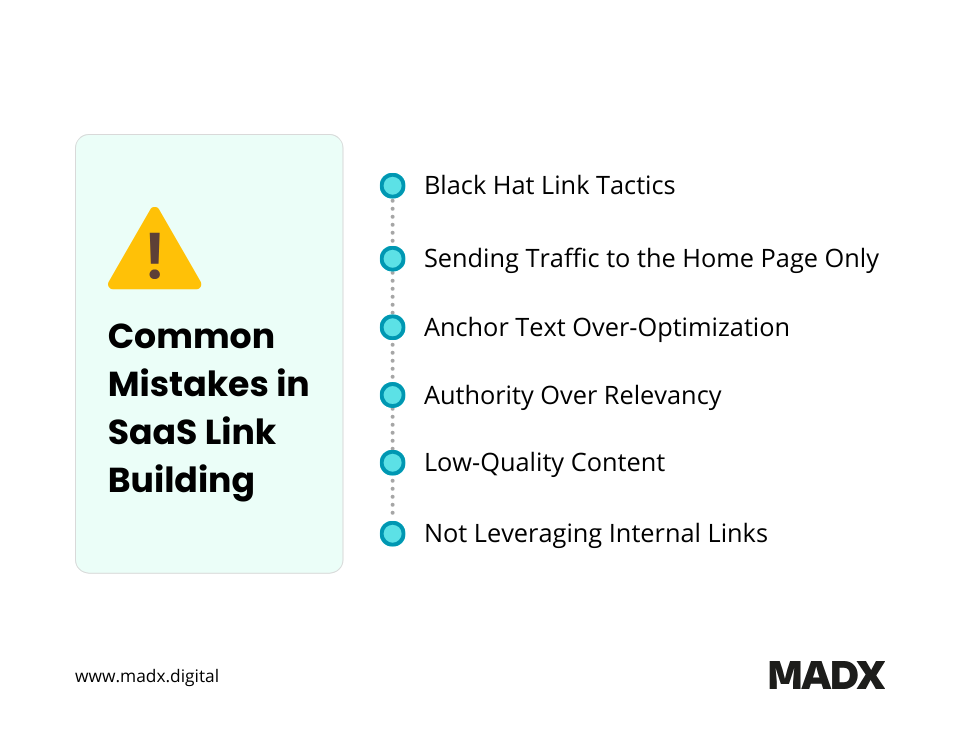
    Common Mistakes in SaaS Link Building

    Most backlinks will help you scale. BUt several others are designed to take down your traffic and rankings. Strategies used to help build them can also lead to your site getting penalized by search engines.

    Here are common mistakes to avoid when building new links.

    Black Hat Link Tactics

    Black hat tactics are sure to ruin your site in the long run.

    Google has a nose for questionable practices, tons of low quality links pointing to your site, general deceit in links and getting links from shady sites or participating in any link program.s

    These practices can harm your domain and business.

    Sending Traffic to the Home Page Only 

    Instead of making the homepage target of all link building send links to targeted landing pages and or other tools or landing pages.

    Anchor Text Over-Optimization 

    Your anchor text should be relevant but don’t try to over-optimize it by adding multiple keywords or using repetitive phrases.

    Authority Over Relevancy 

    Getting links from quality authority sites is good as long as the links themselves are relevant to your business. Getting links from ecommerce sites however authoritative they may be won’t help much in driving your own rankings up.

    Low-Quality Content 

    Most businesses start guest posting to encourage links but with low quality AI built content getting posted, you’re not getting high quality links and that’s destroying your chances of getting better coverage.

    Not Leveraging Internal Links 

    Internal links are a low-cost way of acquiring links.  With internal links you can use any anchor to drive link juice around and internal linking structure also informs search engines about your page.

    Taking care of these mistakes can help your link building strategy so it doesn’t get penalized by search engines.

    Proven Effective Link Building Strategies for SaaS

    Here are some proven SaaS seo link building strategies to test and see if they work for you.

    1. Create Linkable Assets

    Many saas businesses do not get links because their content isn’t great.

    No one wants to send their audience to shallow content that nobody spent any time researching. That offers very little in terms of value.

    THe key to winning links is to invest time and effort to create content that rings with people offering real insights that the audience can’t see elsewhere.

    Pick a narrow niche and cover all possible angles. Trying to be broad topiced will spread these efforts thin. And if content isn’t good enough, getting links will be uphill.

    Here are some content types that consistently earn organic backlinks:

    1. Statistics & Reports – People love binging on data. SO when you publish content covering unique marketing insights people will start referencing your content and start linking to you.
    2. For instance we could publish a SaaS stats article that can drive links and traffic for us.
    1. GuidesLong-form content gets 77.2% more backlinks than short articles. Go deep and make it the go-to resource on the topic.
    2. Glossary Pages – Define industry terms in one place. And when people find that page most sites start linking to that glossary as a point of reference
    3. Pillar & Cluster Content –This helps build authority in the niche and many sites use this to form an interconnected web of content.
    4. Expert Roundups – Industry pros get quoted all the time. Interview experts, compile their insights, and watch the backlinks roll in.

    8. Product Embed 

    This isn’t really for everyone. Probably for SaaS tools that function  as a tool on websites. Let’s say a chatbox SaaS or a forms app.
    Sitegpt is a good example of a business that embeds itself on customer sites and that gives them natural sitewide links to its pages.

    This is what it looks like: 

    With this strategy and enough users, the tool can generate thousands of links in no time.

    These mentions aren’t annoying and serve as natural referrals for your business.

    9. Shareable Links 

    If your tool helps people, do follow links are another great way to accrue links.
    When users share their projects on the internet they can share profile links. Educate users about these links.

    10. Give Testimonials 

    If you are a SaaS company its likely that you use different tools to make life easier. One tool for seo, another to manage time and projects, a CRM, cms systems etc.

    This gives you plenty of opportunities to add testimonials as a powerful user of these different tools. This gives you links back to your brand.

    YOu can also give reviews of services you’re using. Some testimonials are only unlinked brand mentions

    11. Podcasting 

    POdcasts have been growing in popularity and there are two ways to make use of that trend.
    Speak on somebody’s podcast and when they feature you you tget a link

    • Feature someone on your podcast, and you earn a backlink when they share that on their website.

    This is a good strategy. You don’t spend a lot of time creating new content. You just speak on a subject where you’re already an expert for half an hour.

    You can also find a set of focused podcasts relevant to your brand.

    12. Thought-leadership Content 

    Engaging content that  forces people to challenge their assumptions appeals to your niche. Brands like Hubspot, Ahrefs and Zapier thrive on this content and they create data backed guides on popular topics or covering recent trends.

    Thought leadership content also enhances credibility for your brand.

    13. Journalist Outreach/Interviews 

    You can begin the narrative of outreaching to jhournalists to get links from authority sites. There are different platforms where journos and reporters hang out actively looking for comments by leaving queries. These replies are then quited by them in their next story.

    Joirnmalists from media like Forbes, and BVusiness insider routitnely hang out here to get the idea of quotes and interviews they often do

    Quotes for just a link are going to ghet rejected.

    14. Product Reviews 

    Product reviews are a great link-building strategy that are ideally great for driving new links, mentions and revenue.

    Get in touch with bloggers who are active in your niche and offer them your product. This should be turn for a few months of subscription of your tool for a review on their site.

    Image Sour

    There are also review aggregating sites like G2 where  you can get reviews of your product posted. Since these sites get plenty of traffic on their own you can drive some sales with your product posted on G2, Capterra and platforms such as those.

    This frees up your time and you get your product up on sites that sends you traffic and leads.

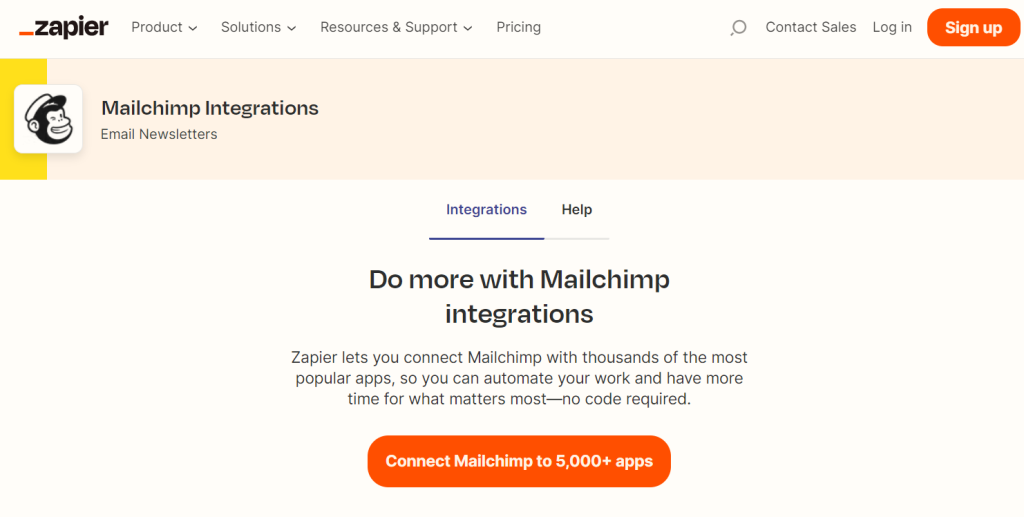
    15. Integration Partners 

    New SaaS tools build in integrations with other tools. This enahcnaces their own limits and serves on unified platforms, saving time.

    These partners can help youw in more links

    Image source 

    16. Conferences 

    You can also be part of condernence sot discuss your tool and improve brand sawresness. Clearsncope participated in webinars and added 12000 new links to their band.

    UYWhen you participate in these webinars, portray the different features relevant to the topic to increase awareness about what your product can do. Back this up with relevant case studies to build trust in your tool.

    17. Run PR Campaigns

    Pr campaigns drive awareness and get you links in the process. PR isn’t however limited to asking for mentions. Its about building lasting relatinshios with journlasts and online sites. If you cold pitch them you are most likely to be ignored

    Invest time in building cnnections. SShare useful resources and when the time arrives you will feature your band.

    Want to tip the scales in your favor? Follow these tips:

    • Stay on top of industry news: With google alerts be notified of breaking stories
    • Craft unique stories: Cover an angle that talks about what makes your business unique 
    • Back up your claims: Journalists don’t like weak stories. Use third party data to back up claims0
    • Keep it simple, silly (KISS): Reporters are terrified of new pitches. Get stragihg to the opint
    • Optimize your outreach: personalize your mails
  • FinanceBoar.com: A Comprehensive Marketing Case Study of Authority Building in Financial Media

    Introduction: The Financial Content Paradox

    Financial content exists in peculiar tension. On one hand, everyone needs financial information—how to save, invest, budget, plan for retirement. The addressable market is essentially every adult human with money. On the other hand, most financial content is either boringly technical, condescendingly simplistic, or thinly veiled sales material for investment products.

    FinanceBoar.com enters this paradoxical landscape with both tremendous opportunity and formidable challenges. This case study examines how a digital financial publication builds authority, attracts audience, generates revenue, and navigates the unique constraints of the financial information industry.

    The Financial Content Landscape: Understanding the Competitive Terrain

    Before analyzing FinanceBoar’s specific strategy, we need to map the competitive ecosystem. Financial media operates across several distinct categories, each with different business models and audience relationships.

    Category 1: Financial News Giants

    Bloomberg, The Wall Street Journal, Financial Times, Reuters. These institutions command massive resources, extensive reporter networks, and unparalleled access to primary sources. They break market-moving news, conduct investigative journalism, and set the agenda for financial discourse.

    Their competitive moat is infrastructure. Bloomberg terminals alone represent a multi-billion dollar ecosystem that individual publications can’t replicate. The WSJ employs hundreds of specialized reporters covering every sector and geography.

    Implication for FinanceBoar: Direct competition is impossible. Any strategy assuming head-to-head rivalry with these players will fail.

    Category 2: Personal Finance Educators

    NerdWallet, The Motley Fool, Investopedia, Bankrate. These properties focus on financial literacy and consumer decision-making. How should you choose a credit card? What’s the best savings account? Should you pay off student loans or invest?

    Their business model typically combines advertising revenue with affiliate commissions. When a reader clicks through to open a credit card or brokerage account, the publication earns a referral fee—often $100-500 per conversion.

    Implication for FinanceBoar: This is the most accessible competitive category, but also the most saturated. Differentiation requires either superior content, better SEO execution, or novel positioning.

    Category 3: Investment Research & Analysis

    Seeking Alpha, The Motley Fool (they span categories), Zacks, Morningstar. These platforms provide stock analysis, portfolio recommendations, and investment research. Some operate freemium models with premium research paywalled; others rely primarily on advertising.

    Implication for FinanceBoar: This space requires significant expertise and faces serious regulatory considerations. Investment advice triggers legal obligations that pure financial education avoids.

    Category 4: Alternative Finance Media

    Substacks from financial writers, YouTube channels, TikTok “finfluencers,” podcasts like Planet Money or The Indicator. These represent the decentralized, personality-driven segment of financial media.

    Implication for FinanceBoar: These demonstrate that audience appetite for financial content delivered with personality and accessibility remains strong. The institutional players haven’t captured all demand.

    Brand Positioning: The “FinanceBoar” Identity

    The name “FinanceBoar” is distinctive, memorable, and slightly aggressive—intentional departures from the conservative, trustworthy-but-bland naming convention of traditional finance brands.

    Deconstructing the Brand Name

    “Finance” – Clearly signals the content domain. No confusion about topic area.

    “Boar” – Evokes strength, determination, persistence. Boars are formidable, strategic, and surprisingly intelligent animals. They’re also associated with being direct and unapologetic.

    The combination suggests a publication that tackles finance fearlessly, without the typical hand-wringing or jargon-laden obfuscation that characterizes much financial content.

    Implied Brand Positioning

    Based on name and typical execution in this space, FinanceBoar likely positions as:

    “Straightforward financial information for people who are tired of being talked down to or sold to.”

    This positioning creates several strategic advantages:

    Advantage 1: Permission to Be Direct
    Unlike traditional financial institutions that must maintain conservative communication, FinanceBoar can be blunt. “That investment strategy is stupid and here’s why” is on-brand in a way that wouldn’t work for Fidelity or Charles Schwab.

    Advantage 2: Distancing from Sales Agendas
    Much financial content exists to funnel readers toward specific products. FinanceBoar’s brand can credibly claim independence and objectivity, increasing trust.

    Advantage 3: Attracting the Underserved
    Traditional financial media often skews toward older, wealthier demographics. FinanceBoar’s brand personality appeals to younger audiences and those who’ve felt excluded or patronized by conventional financial institutions.

    Target Audience: Who Reads FinanceBoar?

    Effective marketing requires crystalline clarity about who you’re serving. Financial content faces particular audience complexity because “everyone needs financial information” is simultaneously true and useless as a targeting strategy.

    Primary Audience Persona: “Ambitious Andrea”

    Demographics:

    • Age: 27-38
    • Income: $65,000-120,000
    • Education: College degree
    • Career: Mid-level professional in tech, marketing, consulting, or similar knowledge work

    Financial Situation:

    • Student loan debt or recently paid off
    • Renting or first-time homeowner
    • Building emergency fund and starting to invest
    • Some retirement savings but anxious it’s not enough
    • Net worth: $20,000-150,000

    Pain Points:

    • Feels behind financially compared to peers
    • Overwhelmed by conflicting financial advice
    • Distrusts traditional financial advisors (fees, conflicts of interest)
    • Wants to DIY finances but lacks confidence
    • Struggles with the gap between financial theory and personal behavior

    Content Preferences:

    • Practical, actionable advice
    • Straight talk without condescension
    • Understanding “why” not just “what”
    • Real examples and case studies
    • Community validation (“I’m not the only one struggling with this”)

    Media Consumption Habits:

    • Primarily mobile device usage
    • Reads during commute, lunch breaks, evening downtime
    • Follows personal finance creators on social media
    • Subscribes to 3-5 email newsletters
    • Listens to podcasts while exercising or commuting

    Secondary Audience Persona: “Career-Focused Carlos”

    Demographics:

    • Age: 32-45
    • Income: $100,000-200,000
    • Education: Advanced degree (MBA, JD, etc.)
    • Career: Senior professional, manager, or entrepreneur

    Financial Situation:

    • Higher income but also higher expenses
    • Homeowner with mortgage
    • Maxing out retirement accounts
    • Interested in optimizing tax strategy
    • Considering investment real estate or alternative investments
    • Net worth: $200,000-750,000

    Pain Points:

    • Time scarcity—can’t become a finance expert
    • Sophisticated enough to spot basic financial BS
    • Wants efficiency and optimization
    • Concerned about making expensive mistakes
    • Interested in wealth building beyond just saving

    Content Preferences:

    • In-depth analysis and strategy
    • Advanced tactics and optimization
    • Tax efficiency and wealth preservation
    • Alternative investments and opportunities
    • Case studies of successful wealth building

    Tertiary Audience: “Information-Seeking Isaac”

    Demographics:

    • Age: 22-28
    • Income: $40,000-70,000
    • Education: College student or recent graduate
    • Career: Entry-level professional or still in school

    Financial Situation:

    • Student loans
    • Little to no savings
    • Just starting to think seriously about finances
    • Possibly still on parents’ health insurance
    • Net worth: Negative to $20,000

    Pain Points:

    • Doesn’t know what he doesn’t know
    • Financial anxiety and feeling overwhelmed
    • Mistakes feel catastrophic with limited resources
    • Influenced by personal finance “gurus” on social media
    • Difficulty separating good advice from hype

    Content Preferences:

    • Beginner-friendly explanations
    • Step-by-step guides
    • Encouragement and hope
    • Success stories from relatable people
    • Myth-busting and protecting against scams

    Content Strategy: The FinanceBoar Editorial Approach

    Financial content strategy must balance multiple competing demands: being authoritative without being boring, accessible without being simplistic, comprehensive without being overwhelming, and honest without being legally risky.

    Content Pillar 1: Personal Finance Fundamentals

    This foundational content addresses the essential questions that every financially-engaged person eventually asks:

    Core Topics:

    • Emergency fund building strategies
    • Debt payoff methodologies (avalanche vs. snowball, refinancing strategies)
    • Budget creation and maintenance
    • Credit score optimization
    • Insurance needs analysis (health, life, disability, property)
    • Tax basics and common deductions

    Marketing Function:
    This content captures broad search traffic from people with specific questions. “How much should I have in emergency fund” generates 40,500 monthly searches according to keyword research tools. “How to build credit score” gets 33,100.

    These topics might not excite experienced finance enthusiasts, but they represent consistent, substantial search demand. They’re the vegetables of the content diet—maybe not the most exciting, but nutritionally essential.

    Production Approach:
    Create comprehensive, definitive guides that fully answer the question. These should be 1,500-2,500 words with clear structure:

    1. Direct answer upfront (for featured snippet optimization)
    2. Explanation of why this matters
    3. Step-by-step implementation guide
    4. Common mistakes to avoid
    5. Frequently asked questions
    6. Tools and resources

    Update annually to maintain accuracy and freshness signals for SEO.

    Content Pillar 2: Investment Education & Strategy

    Moving beyond basics, this content serves people ready to grow wealth through investing:

    Core Topics:

    • Index fund investing philosophy and implementation
    • 401(k) and IRA optimization strategies
    • Asset allocation for different life stages
    • Taxable vs. tax-advantaged account strategies
    • Dividend investing approaches
    • Real estate investment fundamentals
    • Cryptocurrency (handled carefully given volatility and regulatory uncertainty)

    Marketing Function:
    Attracts more sophisticated readers with higher income and net worth—precisely the demographic advertisers pay premium rates to reach. Also positions FinanceBoar as authoritative beyond just basic financial literacy.

    Critical Consideration:
    This content must avoid crossing the line into specific investment advice, which triggers regulatory obligations. The distinction:

    ✓ Acceptable: “Index funds offer diversification and low costs, making them suitable for many long-term investors.”

    ✗ Problematic: “You should invest in Vanguard Total Stock Market Index Fund; it will outperform active management.”

    The former is general education; the latter is specific investment advice. Publications providing investment advice may need to register as investment advisors or partner with registered advisors—substantial compliance overhead.

    Production Approach:
    Balance evergreen strategy content with timely market commentary. The strategy pieces (asset allocation, tax optimization) maintain SEO value long-term. Market commentary (“What the Fed Rate Decision Means for Your Portfolio”) drives immediate traffic and positions the publication as current.

    Content Pillar 3: Financial Psychology & Behavior

    This is where FinanceBoar can truly differentiate. Most financial content focuses on mechanics (“how to invest”) while ignoring psychology (“why don’t I follow through on my investment plan?”).

    Core Topics:

    • Understanding and overcoming psychological barriers to saving
    • Decision-making under financial stress
    • Couples and financial communication
    • Lifestyle inflation and hedonic adaptation
    • Fear and greed in investment decisions
    • Financial independence and early retirement psychology
    • Relationship between money and happiness

    Marketing Function:
    Creates emotionally resonant content that gets shared extensively. People rarely share a compound interest calculator, but they enthusiastically share articles that articulate their internal struggles with money.

    This content also builds deeper reader relationships. When publication addresses not just “what to do” but “why it’s hard and how to actually do it,” readers feel understood rather than lectured.

    Production Approach:
    Combine research from behavioral economics and psychology with real stories. Interview real people (anonymized if needed) about their financial journeys. Reference academic research but translate into accessible language.

    Example: Rather than a dry explanation of loss aversion, tell the story of someone who held a losing stock position for three years rather than accepting the loss, explaining the psychological forces at play.

    Content Pillar 4: Financial News & Current Events

    Timely coverage of financial developments, policy changes, and economic trends.

    Core Topics:

    • Federal Reserve decisions and implications
    • Tax law changes and planning opportunities
    • Major market movements and context
    • Financial regulation developments
    • Economic indicators and what they mean for individuals
    • Corporate earnings and sector trends

    Marketing Function:
    Establishes FinanceBoar as current and connected to real-time developments. Creates recurring reasons to visit and check for updates. Enables newsletter content that provides value beyond what readers could get from just browsing the archive.

    Production Approach:
    Speed matters for news, but analysis matters more. FinanceBoar can’t break news faster than Bloomberg or Reuters. The value is contextualizing developments for the target audience: “What does the Fed rate cut mean for YOUR mortgage rate, savings account, and investment strategy?”

    Aim for publication within 4-6 hours of major developments—fast enough to be timely, but allowing for thoughtful analysis rather than rushed hot takes.

    Content Pillar 5: Tools, Calculators & Interactive Resources

    Financial content lends itself beautifully to interactive tools that provide immediate utility.

    Resource Examples:

    • Retirement calculator with multiple scenarios
    • Debt payoff calculator comparing strategies
    • Investment return projection tools
    • Budget templates and trackers
    • Net worth calculator
    • Fire (Financial Independence, Retire Early) calculator
    • Tax withholding optimizer
    • Mortgage vs. rent calculator

    Marketing Function:
    These tools generate exceptional SEO value, backlinks, and bookmarks. When someone needs a retirement calculator, they’re likely to use it multiple times over months or years, creating recurring traffic.

    Tools also provide email capture opportunities. “Enter your email to save your results” converts well because users genuinely want to preserve their work.

    Production Approach:
    Invest in quality development. A calculator that’s buggy or produces obviously incorrect results destroys credibility. Consider partnering with developers or using established financial libraries to ensure accuracy.

    Make tools embeddable so other websites can use them with attribution—each embed becomes a backlink and traffic source.

    SEO Strategy: Dominating Financial Search Results

    For FinanceBoar, organic search likely represents 40-60% of total traffic. SEO isn’t just a marketing tactic; it’s fundamental to the business model.

    Keyword Strategy & Topic Clustering

    Financial search queries fall into distinct categories with different SEO dynamics:

    Category 1: High-Volume, High-Competition Questions
    Examples: “how to invest money,” “best savings account,” “how to budget”

    These keywords attract millions of monthly searches but face intense competition from established players with massive domain authority. FinanceBoar must approach these strategically rather than hoping to rank #1 immediately.

    Strategy:
    Create the absolute best, most comprehensive resource on the topic—so good that other sites naturally link to it. Use topic clustering: create a pillar page covering “how to invest money” comprehensively, then supporting cluster pages on “how to invest $1,000,” “how to invest in your 20s,” “how to invest for retirement,” etc. Internal linking between these pages signals topical authority to Google.

    Category 2: Medium-Volume, Medium-Competition Long-Tail Queries
    Examples: “Roth IRA conversion tax implications,” “is whole life insurance worth it,” “how much house can I afford on 80k salary”

    These keywords attract thousands rather than millions of monthly searches, but face less intense competition. This is where FinanceBoar can win rankings more quickly.

    Strategy:
    Systematic coverage of these queries with high-quality, specific answers. Create content calendars ensuring comprehensive topic coverage within each major category (retirement, investing, insurance, real estate, etc.).

    Category 3: Low-Competition, Specific Questions
    Examples: “mega backdoor Roth IRA explanation,” “tax loss harvesting rules,” “series I bond vs TIPS bonds”

    These highly specific queries might only generate hundreds of monthly searches but face minimal competition. Ranking #1 is achievable.

    Strategy:
    Cover systematically, especially when they represent questions the target audience asks. These pages may not drive huge traffic individually, but collectively they establish topical authority and attract qualified readers.

    Technical SEO Fundamentals

    Content quality matters most, but technical execution determines whether Google can properly crawl, index, and rank that content.

    Critical Technical Elements:

    Site Speed:
    Page load time affects both rankings and user experience. Target under 2 seconds on desktop, under 3 seconds on mobile. Optimize images, minimize JavaScript, use CDN for asset delivery, implement caching.

    Mobile Optimization:
    Google uses mobile-first indexing. The mobile version of FinanceBoar IS the version Google primarily evaluates. Responsive design is non-negotiable.

    Structured Data Markup:
    Schema.org markup helps Google understand content types and generate rich snippets. For financial content, particularly valuable schemas include:

    • Article schema (for blog posts)
    • FAQ schema (for question-based content)
    • HowTo schema (for step-by-step guides)
    • Breadcrumb schema (for site navigation)

    Rich snippets dramatically increase click-through rates from search results.

    Internal Linking Architecture:
    Strategic internal linking distributes page authority throughout the site and helps Google understand topical relationships. Every piece of content should link to and receive links from related content.

    URL Structure:
    Clean, descriptive URLs that indicate content hierarchy and topic.

    Good: financeboar.com/investing/index-funds/vanguard-vs-fidelity
    Bad: financeboar.com/p=12345?cat=inv

    HTTPS & Security:
    Non-negotiable. Google explicitly uses HTTPS as a ranking signal, and users (rightfully) distrust non-secure sites, especially for financial content.

    Link Building for Financial Content

    Backlinks remain one of Google’s most important ranking factors. Quality links from authoritative sites signal that FinanceBoar deserves to rank well.

    Link Building Strategy 1: Create Linkable Assets
    Original research, comprehensive guides, useful tools—content so valuable that other sites naturally reference it.

    Examples:

    • Annual survey: “The State of Millennial Finances 2026”
    • Comprehensive resource: “The Complete Guide to Financial Independence”
    • Interactive tool: “Ultimate Retirement Planning Calculator”

    Link Building Strategy 2: Expert Commentary
    Position FinanceBoar writers as quotable experts. Services like HARO (Help A Reporter Out) connect journalists with expert sources. Providing quotes for articles in major publications earns both backlinks and credibility.

    Link Building Strategy 3: Guest Contributions
    Writing for other respected financial publications. Forbes, Business Insider, and similar outlets accept contributor content. Each published piece includes author bio linking back to FinanceBoar.

    Link Building Strategy 4: Relationship Building
    Connect with other financial content creators, bloggers, and publications. Genuine relationships lead to natural linking opportunities, podcast appearances, and collaborative projects.

    What NOT To Do:
    Buying links, participating in link schemes, or using manipulative tactics will eventually trigger Google penalties that can devastate organic traffic. The risk vastly outweighs any short-term benefit.

    Email Marketing: Building the Owned Audience

    Email represents FinanceBoar’s most valuable asset. While social platforms and Google can change algorithms overnight, the email list remains under FinanceBoar’s control.

    Newsletter Strategy & Segmentation

    Financial audiences have diverse needs. A single newsletter trying to serve everyone serves no one particularly well.

    Newsletter 1: Daily Financial News Digest
    Target: Engaged readers who want to stay current
    Format: 5-7 headlines with one-sentence summaries, published 6am daily
    Length: 3-4 minute read
    Monetization: Single sponsor per send

    Newsletter 2: Weekly Deep Dive
    Target: Readers interested in detailed analysis
    Format: One major topic explored comprehensively each week
    Length: 10-12 minute read
    Monetization: Multiple sponsors, affiliate links where relevant

    Newsletter 3: Monthly Financial Checklist
    Target: People who want actionable tasks
    Format: Specific actions to take this month (rebalance portfolio, review credit report, etc.)
    Length: 5-6 minute read
    Monetization: Affiliate partnerships with financial services

    Newsletter 4: Investing-Focused
    Target: Subscribers specifically interested in investment content
    Format: Market analysis, investment strategy, portfolio discussion
    Length: 8-10 minute read
    Monetization: Premium subscription option with additional content

    Segmentation Value:
    Rather than one newsletter with 50,000 subscribers averaging 20% open rates, four targeted newsletters with 15,000-20,000 subscribers each averaging 30-40% open rates delivers more total engagement and revenue.

    Subscribers indicate preferences during signup: “Which topics interest you most?” Algorithms can also infer preferences based on which articles someone reads.

    Email Conversion Optimization

    The email list only generates value if subscribers actually open and engage with messages.

    Subject Line Best Practices:

    • Keep under 50 characters (mobile optimization)
    • Create curiosity without clickbait
    • Use numbers when relevant (“5 Tax Moves Before December 31”)
    • Personalization increases open rates (“Andrea, you’re making this mistake”)
    • A/B test systematically

    Content Structure:

    • Open with immediate value (don’t bury the lede)
    • Write conversationally (emails should feel personal, not corporate)
    • Single clear call-to-action per email
    • Mobile-first design (60%+ of email opens happen on mobile)

    Send Time Optimization: For financial content, engagement peaks:

    • Weekday mornings 6-8am (commute reading)
    • Lunch hours 12-1pm
    • Early evenings 6-7pm

    Test for your specific audience. Send time can vary significantly based on demographics.

    Social Media Strategy: Building Community Beyond the Website

    Social platforms provide distribution, engagement, and brand building opportunities—but each platform requires distinct strategy.

    LinkedIn: Professional Financial Discourse

    LinkedIn’s professional context makes it ideal for financial content, especially for FinanceBoar’s target audience of career-focused professionals.

    Content Strategy:

    • Career finance topics (negotiating salary, equity compensation, benefits optimization)
    • Economic analysis and market commentary
    • Personal finance success stories
    • Poll questions driving engagement
    • Document posts (carousels explaining financial concepts)

    Posting Cadence: 4-5x weekly for page, daily for individual team members

    Engagement Approach: LinkedIn rewards genuine discussion. Respond thoughtfully to comments, ask questions, engage with other creators’ content.

    Twitter/X: Real-Time Financial Commentary

    Twitter’s strength is immediacy and conversation. Ideal for timely market reactions and building direct relationships with audience members.

    Content Strategy:

    • Breaking financial news commentary
    • Threading complex topics into digestible explanations
    • Engaging with followers’ questions
    • Controversial takes (carefully) that spark discussion
    • Charts and data visualizations

    Posting Cadence: 3-5x daily, more during major financial events

    Engagement Approach: Twitter rewards personality. FinanceBoar’s voice can be more casual and direct here than in formal articles.

    Instagram: Visual Financial Education

    Instagram requires translating financial concepts into visual formats—challenging but increasingly important as younger audiences gravitate to visual platforms.

    Content Strategy:

    • Infographics explaining financial concepts
    • Chart visualizations of data
    • Behind-the-scenes of content creation
    • Stories for daily tips and engagement
    • Reels explaining quick financial concepts (60-90 seconds)

    Posting Cadence: 4-5x weekly for feed, daily stories, 3-4 reels weekly

    YouTube: Long-Form Financial Education

    Video content enables different explanations than text. Many financial concepts (like how compound interest works visually) lend themselves well to video.

    Content Strategy:

    • Explainer videos on financial topics
    • Market analysis and commentary
    • Portfolio reviews (using hypothetical examples)
    • Financial tool tutorials
    • Interviews with financial experts

    Production Consideration: Video requires significantly more resources than text. Start lean—simple screen recordings with voiceover, improving production values as audience grows.

    Reddit: Community Engagement (Carefully)

    Reddit communities like r/personalfinance, r/investing, and r/financialindependence represent millions of engaged users. But heavy-handed self-promotion backfires catastrophically.

    Engagement Strategy:

    • Genuinely participate in communities (answer questions, provide value)
    • Only share FinanceBoar content when directly relevant and genuinely helpful
    • Consider hosting AMAs (Ask Me Anything) to build visibility
    • Never use promotional language

    Done correctly, Reddit can drive enormous traffic. Done incorrectly, communities ban you and damage your reputation.

    Monetization: Building Sustainable Revenue

    Financial publications have unusual monetization advantages: the audience is interested in money and often willing to spend it, and advertisers pay premium rates to reach financially-engaged users.

    Revenue Stream 1: Display Advertising

    Standard banner and sidebar ads provide baseline revenue.

    Network Options:

    • Google AdSense (easy but lower CPMs, typically $2-5)
    • Mediavine or AdThrive (require traffic minimums but deliver higher CPMs, $8-15+)
    • Direct sponsorship sales (highest CPMs but requires sales effort)

    Optimization:

    • Ad placement testing (sidebar vs. in-content vs. end of article)
    • Viewability optimization ensuring ads actually seen
    • Balance: more ads = more revenue per visitor but worse experience

    Revenue Stream 2: Affiliate Commissions

    When readers click through FinanceBoar’s links to financial products and take action (open account, sign up for service), FinanceBoar earns commission.

    High-Value Affiliate Categories:

    • Brokerage accounts ($50-200 per signup)
    • Credit cards ($50-250 per approval)
    • Savings accounts ($25-100 per account)
    • Robo-advisors ($50-150 per funded account)
    • Insurance quotes ($3-15 per quote)

    Critical Consideration:
    Affiliate relationships create potential conflicts of interest. FinanceBoar must recommend products that genuinely serve readers, with affiliate relationships disclosed transparently. Recommending inferior products for higher commissions destroys trust.

    Revenue Stream 3: Premium Subscription/Membership

    Paywalling some content behind subscription converts highly engaged readers into recurring revenue.

    Potential Premium Content:

    • Advanced investment analysis
    • Detailed portfolio recommendations
    • Interactive community access
    • One-on-one financial coaching
    • Ad-free experience
    • Exclusive tools and calculators

    Pricing Model:
    $10-15/month or $100-150/year. With 100,000 monthly readers, even 1% conversion yields 1,000 subscribers × $12/month = $12,000 monthly recurring revenue.

    Revenue Stream 4: Courses & Educational Products

    FinanceBoar’s expertise can be packaged into structured educational products.

    Course Examples:

    • “Financial Independence Blueprint: 8-Week Course” ($297)
    • “Advanced Investing Strategies Masterclass” ($497)
    • “Real Estate Investing Fundamentals” ($197)

    Advantage: High margins (80%+), product created once and sold repeatedly

    Disadvantage: Requires marketing effort beyond regular content promotion

    Revenue Stream 5: Consulting & Advisory Services

    For higher-net-worth audience members, one-on-one financial consulting commands premium pricing.

    Consideration: Providing investment advice requires registration as investment advisor or partnership with registered advisors. Financial planning has fewer regulatory barriers than investment management.

    Regulatory Considerations: Navigating Financial Content Rules

    Financial content faces unique legal considerations that publishers in other niches don’t encounter.

    Investment Advice vs. Investment Education

    The distinction matters enormously:

    Investment Education (Generally Allowed):
    “Diversification reduces risk. Many investors use index funds to achieve diversification efficiently.”

    Investment Advice (May Require Registration):
    “You should allocate 60% to stocks and 40% to bonds. Buy Vanguard Total Stock Market Index.”

    The former discusses principles; the latter provides specific recommendations.

    Required Disclosures

    Affiliate Relationships: FTC requires clear disclosure when content includes affiliate links. “We may earn commission if you click links in this article.”

    Conflicts of Interest: If FinanceBoar has financial relationships with products recommended, readers deserve to know.

    Investment Risk: Content discussing investments should include appropriate risk disclaimers.

    Accuracy and Liability

    Financial misinformation can cause real financial harm. FinanceBoar must:

    • Fact-check rigorously
    • Update content when information changes (tax laws, contribution limits, etc.)
    • Correct errors promptly and transparently
    • Consider legal review for particularly sensitive content

    Conclusion: The FinanceBoar Path to Authority

    FinanceBoar operates in a competitive but opportunity-rich market. Financial literacy demand continues growing as people recognize they can’t rely on employers or government to secure their financial futures.

    Success requires:

    1. Unwavering Commitment to Reader Value
    Never recommend products solely because they pay higher commissions. Never publish misleading content for clicks. Trust, once lost, cannot be recovered.

    2. Consistent, High-Quality Content Production
    Publishing schedules matter. Readers develop habits around content they can depend on.

    3. Multi-Channel Distribution
    SEO provides foundation, email builds owned audience, social creates engagement, partnerships extend reach.

    4. Diversified Revenue
    No single monetization stream should exceed 50% of revenue. Diversification provides resilience.

    5. Community Building
    The publications that thrive long-term create communities where readers connect with each other, not just consume content.

    Financial media isn’t just about information transmission. It’s about empowerment, about helping people take control of their financial lives. When FinanceBoar succeeds at that mission, the business results follow.

    That’s not just a marketing strategy. That’s a purpose worth building toward.

  • The OctetNew.com Marketing Blueprint: A Deep-Dive Analysis of Digital Strategy in the Tech News Landscape

    Introduction: Navigating the Attention Economy

    The digital news ecosystem is brutal. Thousands of technology-focused publications compete for the same eyeballs, the same advertising dollars, the same fleeting moments of attention. In this saturated marketplace, OctetNew.com represents a fascinating case study in how emerging digital properties can carve out territory and build sustainable audience relationships.

    This analysis examines OctetNew’s marketing strategy through multiple lenses: content positioning, audience development, monetization architecture, competitive differentiation, and growth mechanics. We’ll explore what works, what doesn’t, and what lessons can be extracted for anyone building a digital media property in 2026.

    Market Context: The Tech News Battlefield

    Before dissecting OctetNew’s specific approach, we need to understand the competitive landscape. The technology news sector operates across distinct tiers, each with different economics and audience relationships.

    Tier 1: The Giants
    TechCrunch, The Verge, Wired, Ars Technica. These established players command massive traffic, prestigious brand recognition, and substantial editorial teams. They break news, set agendas, and attract the industry’s top writing talent. Competing directly with these properties is futile for newcomers.

    Tier 2: The Specialists
    Publications like Protocol (before its closure), The Information, and Stratechery occupy this space. They succeed through deep specialization—covering specific beats with unmatched depth, offering proprietary research, or providing analysis unavailable elsewhere. Their moat is expertise.

    Tier 3: The Emerging Players
    This is where OctetNew competes. Properties at this level must be scrappier, nimbler, and more creative in their approach. They can’t outspend the giants or out-expert the specialists. They need different advantages.

    The question becomes: How does an emerging tech news property build audience, authority, and revenue when competing against well-funded incumbents?

    Brand Positioning: The “New” in OctetNew

    The name itself signals intent. “Octet” suggests technology (eight bits to a byte), precision, and completeness. “New” emphasizes freshness, timeliness, and a forward-looking perspective. Together, they position the publication as both technically credible and oriented toward what’s emerging rather than what’s established.

    The Positioning Statement (implied through brand execution):
    “OctetNew delivers timely technology news and analysis for professionals who need to stay ahead of industry developments without wading through noise.”

    This positioning creates several strategic advantages:

    Advantage 1: Clear Audience Definition
    The target reader isn’t a casual tech enthusiast. They’re a professional—a developer, product manager, investor, or executive—for whom technology intelligence has career or business implications. This clarity enables precise content decisions and advertiser targeting.

    Advantage 2: Permission to Curate
    By positioning around “new” developments, the publication can legitimately aggregate, synthesize, and contextualize information from multiple sources rather than requiring expensive original reporting for every piece.

    Advantage 3: Niche Flexibility
    Unlike deeply specialized publications, OctetNew can cover the breadth of technology topics while maintaining focus on what’s emerging. AI developments, cryptocurrency trends, developer tools, enterprise software—all fair game as long as there’s a “new” angle.

    Content Strategy: The Editorial Engine

    Content is simultaneously the product, the marketing, and the moat. For OctetNew, the content strategy must accomplish multiple objectives: attract new readers, retain existing audience, establish authority, and support monetization. That’s a lot of weight for articles to carry.

    Content Pillar Architecture

    Effective digital publications organize around distinct content pillars, each serving specific purposes within the overall strategy.

    Pillar 1: Breaking News & Trend Coverage
    Short-form updates on significant technology announcements, funding rounds, product launches, and industry developments. These pieces prioritize speed and accuracy over depth.

    Marketing Value: SEO discovery through timely keyword targeting, social media virality potential, establishing the publication as current and reliable.

    Production Approach: Lean editorial process, possibly AI-assisted drafting for speed, multiple daily updates.

    Example Topic: “OpenAI Announces GPT-5: Key Features and Industry Implications”

    Pillar 2: Analysis & Commentary
    Medium-form pieces (800-1,200 words) that provide context, interpretation, and perspective on major technology trends. This is where editorial voice and expertise become differentiators.

    Marketing Value: Demonstrates thought leadership, creates shareable content that sparks discussion, builds reader loyalty through distinctive perspectives.

    Production Approach: Staff writers or regular contributors with subject matter expertise, weekly publication cadence.

    Example Topic: “Why Enterprise AI Adoption Is Slower Than Headlines Suggest: A Data-Driven Analysis”

    Pillar 3: Deep Dives & Investigative Features
    Long-form content (2,000+ words) that explores topics with unusual depth. Comprehensive guides, investigative reporting, or exhaustive analysis of complex subjects.

    Marketing Value: Cornerstone content that attracts backlinks, positions the publication as authoritative, generates sustained organic search traffic.

    Production Approach: Monthly or bi-monthly flagship pieces, potentially involving multiple team members, extensive research.

    Example Topic: “The Complete Technical Architecture of Modern Content Delivery Networks: How Your Data Travels the Internet”

    Pillar 4: Practical Resources & Tools
    Actionable content that readers can immediately use: tutorials, tool comparisons, buying guides, career advice, coding examples.

    Marketing Value: High engagement and bookmark rates, strong conversion potential for email list building, establishes utility beyond entertainment.

    Production Approach: Template-based production for efficiency, updated regularly to maintain accuracy.

    Example Topic: “2026 Developer Tools Comparison: The 15 Best Code Editors Ranked and Reviewed”

    The Publishing Cadence

    Consistency matters more than volume. Research from Content Marketing Institute consistently shows that regular, predictable publishing builds audience habit and trust more effectively than sporadic high-volume bursts.

    For OctetNew, an effective cadence might include:

    • Daily: 3-5 breaking news items or short updates
    • Weekly: 2-3 analysis pieces
    • Bi-weekly: 1 deep-dive feature
    • Monthly: 1-2 comprehensive guides or resources

    This provides roughly 100+ pieces of content monthly—substantial enough to attract search traffic and maintain audience engagement without requiring an unsustainably large editorial team.

    Content Distribution: Beyond the Homepage

    Creating great content means nothing if nobody sees it. Modern content marketing requires multi-channel distribution strategies that meet audiences where they already spend time.

    Owned Distribution Channels:

    The Website
    Obviously primary, but too often publications assume “build it and they will come.” The site must be optimized for discovery (SEO), engagement (internal linking, related content recommendations), and conversion (email signup prompts, social sharing buttons).

    Email Newsletters
    The most underrated distribution channel. Email open rates in the tech news category typically hover around 20-30%—far higher than social media engagement rates. OctetNew likely maintains multiple newsletter formats:

    • Daily Brief: Curated headlines with one-sentence summaries (low time investment for readers, high open rates)
    • Weekly Deep Dive: Longer analysis pieces sent to engaged subscribers
    • Topic-Specific Newsletters: Separate lists for AI news, developer tools, cryptocurrency, etc.

    The segmentation allows personalization without overwhelming subscribers. Someone interested in AI developments doesn’t necessarily want cryptocurrency updates.

    Mobile App (If Applicable)
    Push notifications for breaking news, offline reading capabilities, personalized feed algorithms. Apps increase engagement metrics but require development investment—likely a later-stage consideration.

    Earned Distribution Channels:

    Organic Search (SEO)
    The long-term traffic foundation. Every piece of content should target specific search intent:

    • Informational queries: “what is edge computing”
    • Comparison queries: “kubernetes vs docker swarm”
    • News queries: “apple quarterly earnings 2026”
    • How-to queries: “how to deploy a web application”

    Technical SEO fundamentals matter: fast page loads, mobile optimization, clean URL structure, proper heading hierarchy, schema markup for rich snippets. But content quality ultimately determines rankings. Google’s algorithms increasingly reward depth, accuracy, and user satisfaction over keyword manipulation.

    Social Media Amplification
    Different platforms serve different purposes for tech news distribution:

    Twitter/X: Real-time news, breaking developments, journalist networking, direct engagement with industry figures. Short-form updates perform best. Threading longer analysis can drive traffic while providing value directly on the platform.

    LinkedIn: Professional context makes this ideal for career-focused content, industry analysis, and B2B topics. Longer-form posts work better here than other platforms. Company executives and decision-makers concentrate on LinkedIn, making it valuable for both audience building and advertiser appeal.

    Reddit: Tricky but potentially powerful. Subreddits like r/technology, r/programming, and niche communities can drive enormous traffic spikes. The challenge? Redditors punish self-promotion ruthlessly. Success requires genuine community participation and only sharing content when legitimately relevant and valuable.

    Hacker News: Similar dynamics to Reddit but focused specifically on technology professionals. A front-page Hacker News post can deliver 50,000+ visitors in 24 hours. The community values technical depth, original insights, and intellectual honesty. Sensationalism backfires.

    Media Mentions & Backlinks
    Getting cited by larger publications amplifies reach and builds domain authority (critical for SEO). This happens through:

    • Original research or data that other journalists reference
    • Expert commentary positioning staff as quotable sources
    • Investigative reporting that breaks news others cover
    • Relationship building with journalists at larger outlets

    Paid Distribution Channels:

    Programmatic Advertising
    Google Ads, Facebook/Instagram, Twitter, LinkedIn, and Reddit all offer paid promotion. For publications, the ROI calculation is straightforward: does the lifetime value of acquired readers exceed the acquisition cost?

    For OctetNew, paid advertising likely focuses on:

    • Promoting flagship content pieces with high conversion potential
    • Retargeting website visitors who didn’t subscribe
    • Targeting competitor audiences with lookalike modeling
    • Sponsoring relevant newsletters or podcasts in adjacent spaces

    Content Syndication Partnerships
    Platforms like Medium, LinkedIn Publishing, or industry-specific aggregators can extend reach. The strategy requires balancing exposure benefits against potential cannibalization of direct traffic.

    Best practice: Publish on owned properties first, then syndicate with canonical tags pointing back to the original. This maintains SEO credit while accessing new audiences.

    Audience Development: Building the Readership Engine

    Traffic is vanity. Engaged audience is sanity. Revenue is reality.

    OctetNew’s audience development strategy must focus on quality over pure quantity. Ten thousand highly engaged professional readers generate more value—both in terms of monetization potential and content impact—than one hundred thousand casual visitors who bounce after fifteen seconds.

    Defining the Target Persona

    Effective audience development starts with crystalline clarity about who you’re serving. OctetNew’s core persona likely looks something like:

    Primary Persona: “Technical Professional Tyler”

    • Age: 28-42
    • Role: Software developer, engineering manager, product manager, or technical founder
    • Career stage: Mid to senior level, making technology decisions or influencing them
    • Pain points: Information overload, difficulty separating signal from noise, need to stay current without constant monitoring
    • Content preferences: Appreciates depth but values brevity, wants analysis beyond surface-level coverage, seeks practical applicability
    • Reading behavior: Mobile-heavy, scan-first reading style, bookmarks for later, shares professionally relevant content

    Secondary Persona: “Investor Iris”

    • Age: 32-55
    • Role: VC, angel investor, or corporate development professional
    • Career stage: Established, makes or influences investment decisions
    • Pain points: Identifying emerging trends early, due diligence on new technologies, understanding technical details without engineering background
    • Content preferences: Market analysis, trend identification, company deep-dives, technical concepts explained accessibly
    • Reading behavior: Newsletter-focused, reads during commute or dedicated reading time, forwards to colleagues

    Tertiary Persona: “Executive Eric”

    • Age: 38-60
    • Role: CTO, CIO, VP of Engineering, or C-suite at tech-adjacent companies
    • Career stage: Senior leadership, sets strategic direction
    • Pain points: Strategic technology decisions, understanding competitive landscape, evaluating vendor claims
    • Content preferences: Business implications of technology trends, case studies, vendor comparisons, regulatory developments
    • Reading behavior: Skims for key insights, delegates detailed reading to team, values executive summaries

    Understanding these personas shapes everything: content topics, language complexity, article length, email send times, even website design choices.

    The Subscription Funnel

    Converting casual visitors into loyal subscribers requires a carefully designed funnel that addresses reader psychology at each stage.

    Stage 1: Awareness
    The reader discovers OctetNew through search, social media, or referral. First impression determines everything. The content must immediately demonstrate value.

    Optimization tactics:

    • Compelling headlines that promise clear value
    • Strong opening paragraphs that deliver on the headline promise
    • Visual design that signals professionalism and credibility
    • Clear categorization helping readers find related content

    Stage 2: Evaluation
    The reader explores further, checking if this publication consistently delivers value. They might read 2-5 articles during this phase.

    Optimization tactics:

    • Related content recommendations keeping readers engaged
    • Consistent quality across articles (nothing destroys trust like erratic quality)
    • Clear editorial voice and perspective differentiating from generic coverage
    • Author bios establishing expertise and credibility

    Stage 3: Conversion
    The reader decides this publication merits ongoing attention and provides their email address.

    Optimization tactics:

    • Strategic subscription prompts (after meaningful engagement, not immediate popups)
    • Clear value proposition for the newsletter (“Curated weekly insights, 5-minute read”)
    • Low-friction signup (email only, no mandatory surveys)
    • Immediate value delivery (welcome email with best content, instant access to subscriber-only resources)

    Stage 4: Engagement
    The new subscriber receives and opens emails, clicks through to articles, and develops reading habits.

    Optimization tactics:

    • Consistent send schedule building expectation
    • Personalization based on topic preferences
    • Re-engagement campaigns for inactive subscribers
    • Exclusive content rewarding subscriber status

    Stage 5: Advocacy
    The loyal reader shares content, refers colleagues, and becomes an active promoter.

    Optimization tactics:

    • Making sharing effortless (one-click social buttons, “forward to colleague” features)
    • Creating share-worthy content (original research, controversial but defensible takes, exceptional utility)
    • Recognition programs (highlighting community contributions, reader spotlights)
    • Referral incentives (though organic advocacy matters most)

    Retention: The Overlooked Metric

    Most publications obsess over acquisition and ignore retention. This is backwards. Retention determines the return on every acquisition dollar spent.

    Key retention metrics OctetNew should monitor:

    Email Open Rates: Industry benchmark is 20-30% for tech publications. Declining open rates signal content relevance problems or send frequency issues.

    Click-Through Rates: 2-5% is typical. This measures whether email content compelling enough to drive action.

    Return Visitor Rate: What percentage of monthly unique visitors are returning vs. new? High return rates indicate strong retention.

    Reading Depth: Scroll depth, time on page, pages per session—these reveal whether content holds attention.

    Unsubscribe Rate: Under 0.5% per send is healthy. Spikes indicate content mismatch or frequency problems.

    Retention improvement often delivers better ROI than acquisition optimization. A 5% improvement in retention can increase customer lifetime value by 25-95% according to research from Bain & Company.

    Monetization Architecture: Building Sustainable Revenue

    Content quality and audience size mean nothing without viable monetization. For digital publications, revenue diversification reduces risk and maximizes value extraction from the audience asset.

    Revenue Stream 1: Display Advertising

    The traditional model, but increasingly challenging. CPMs (cost per thousand impressions) for tech content typically range from $3-10 depending on audience quality and advertiser demand.

    Economics Example:

    • 500,000 monthly pageviews
    • $6 average CPM
    • Revenue: $3,000/month

    That’s $36,000 annually—insufficient as a sole revenue source unless traffic scales dramatically. But as one component of a diversified model, display advertising provides baseline recurring revenue.

    Optimization strategies:

    • Premium ad networks (Carbon Ads, BuySellAds for tech audiences)
    • Header bidding to maximize CPM through competition
    • Strategic ad placement balancing revenue and user experience
    • Viewability optimization ensuring ads actually seen

    The Attention Trade-off:
    More ads increase revenue per visitor but degrade experience, potentially reducing retention and traffic growth. The optimal balance varies by publication, but research suggests 2-3 ads per page maximizes total revenue by preserving traffic growth.

    Revenue Stream 2: Sponsored Content & Native Advertising

    Technology companies will pay premium rates for access to professional audiences through editorial content that doesn’t look like traditional advertising.

    Rate Card Typical Range:

    • Sponsored article: $2,000-8,000 depending on audience size and advertiser category
    • Newsletter sponsorship: $1,500-5,000 per send
    • Multi-article campaign: $10,000-50,000

    Critical Success Factor:
    Maintaining editorial integrity. Sponsored content must be clearly labeled, provide genuine value to readers, and align with publication standards. Violating reader trust for short-term revenue destroys long-term value.

    Revenue Stream 3: Premium Subscriptions

    Paywalls convert a small percentage of readers into paying subscribers willing to fund quality journalism. The New York Times, The Information, and Stratechery prove this model works.

    Pricing Strategy Considerations:

    Freemium Model: Most content free, premium features/content paywalled

    • Advantage: Maximizes reach and SEO value
    • Disadvantage: Difficult conversion, most readers never pay

    Metered Model: X free articles monthly, then paywall

    • Advantage: Lets readers sample before committing
    • Disadvantage: Complex implementation, user frustration

    Hard Paywall: All or most content requires subscription

    • Advantage: Higher per-subscriber value, clear value proposition
    • Disadvantage: Dramatically limits reach and discovery

    For OctetNew, a metered model likely makes most sense: 5-10 free articles monthly, then $10-15/month subscription. With 500,000 monthly visitors, even a 1% conversion rate yields 5,000 subscribers × $12/month = $60,000 monthly recurring revenue.

    Revenue Stream 4: Events & Community

    Physical or virtual events leverage audience relationships into high-margin revenue. A well-executed conference or webinar series can generate substantial income while strengthening community bonds.

    Event Types:

    • Annual conference ($500-2,000 tickets, sponsorship revenue)
    • Monthly webinars (lead generation for advertisers, premium content for subscribers)
    • Workshops and training (leveraging editorial expertise)
    • Community meetups (lower revenue but strong engagement)

    Revenue Stream 5: Affiliate Commissions & Tool Partnerships

    When OctetNew reviews or recommends technology tools, affiliate relationships generate commissions from resulting purchases. This works best with high-ticket items (enterprise software, premium tools) where commissions justify the relationship overhead.

    Strategic Considerations: Editorial independence must be preserved. Recommendations should be genuinely meritocratic, with affiliate relationships disclosed transparently.

    Competitive Differentiation: What Makes OctetNew Distinct?

    In a crowded market, differentiation determines survival. OctetNew needs clear answers to: “Why should someone read us instead of TechCrunch, The Verge, or Hacker News?”

    Differentiation Strategy 1: Curation as Core Value

    Rather than trying to out-report giant newsrooms, position as the essential filter. “We read everything so you don’t have to.” This reframes the competitive dynamic from content creation to attention management.

    Differentiation Strategy 2: Community Intelligence

    Building genuine community—through comments, forums, or dedicated spaces—creates network effects competitors can’t easily replicate. The community becomes both content source (user insights, discussions) and retention mechanism.

    Differentiation Strategy 3: Vertical Depth in Emerging Areas

    Focus intensely on specific emerging technology areas where established players provide only surface coverage. Become the authoritative voice on quantum computing, edge AI, or whatever domain offers opportunity.

    Differentiation Strategy 4: Accessibility Without Dumbing Down

    Technical content explained clearly but not simplistically. Threading the needle between developer-level detail and executive accessibility creates unique positioning.

    Growth Mechanics: Scaling the Operation

    Sustainable growth requires systems, not heroics. OctetNew’s growth strategy should focus on creating repeatable processes for content creation, audience development, and monetization.

    Content Production Scaling

    Editorial System:

    • Content calendar planning topics 4-6 weeks ahead
    • Style guides ensuring consistency across writers
    • Template-based production for recurring content types
    • Editorial workflow from pitch to publication standardized

    Team Structure:

    • Managing editor coordinating overall strategy
    • 2-3 staff writers for core content production
    • Network of freelance specialists for deep expertise
    • Editorial assistant for coordination and research

    Technology Infrastructure

    Core Platform Requirements:

    • Fast, reliable CMS (WordPress, Ghost, or custom)
    • Email service provider with automation (ConvertKit, Mailchimp, or Substack)
    • Analytics infrastructure (Google Analytics, Mixpanel)
    • Ad serving and optimization platform

    Growth Tools:

    • SEO optimization suite (Ahrefs, SEMrush)
    • Social media scheduling and analytics
    • A/B testing for conversion optimization
    • Subscriber management and segmentation

    Metrics Dashboard

    What gets measured gets managed. OctetNew should track:

    Audience Metrics:

    • Monthly unique visitors and pageviews
    • Email subscriber count and growth rate
    • Open rates, click rates, unsubscribe rates
    • Return visitor percentage
    • Social media following and engagement

    Content Metrics:

    • Top performing articles by traffic, engagement, conversion
    • Search rankings for target keywords
    • Backlink acquisition
    • Social shares and referral traffic

    Revenue Metrics:

    • Monthly recurring revenue by source
    • Customer acquisition cost
    • Lifetime value per subscriber
    • Revenue per thousand visitors

    Conclusion: The Path Forward

    OctetNew operates in a challenging but opportunity-rich environment. The technology news landscape rewards publications that provide genuine value, build authentic communities, and maintain consistent quality.

    Success requires:

    • Clear positioning differentiating from competitors
    • Content strategy balancing immediacy and depth
    • Multi-channel distribution maximizing reach
    • Engaged audience development prioritizing retention
    • Diversified monetization reducing dependency risk
    • Systems enabling sustainable scaling

    The publications that thrive won’t necessarily be the biggest or fastest. They’ll be the ones that understand their audience deeply, serve them exceptionally, and build sustainable business models supporting quality journalism.

    That’s the blueprint. Execution determines everything.

  • Case Study 4: BlogHold.com – Portfolio Aggregation Strategy

    The Meta-Business Model

    BlogHold represents a fascinating marketing challenge: it’s a platform about platforms. Whether this is a blog network, a holding company for digital properties, or a content aggregator, the marketing must work on two levels.

    Level 1: Marketing to content creators
    Convincing bloggers or publishers to join the network, contribute content, or be acquired.

    Level 2: Marketing to end consumers
    Building audience awareness and traffic across the portfolio.

    Value Proposition to Creators

    If BlogHold acquires or partners with blogs, the pitch centers on:

    Monetization improvement: “We’ll help you make more money from your existing traffic through better ad optimization, diversified revenue streams, and our advertiser relationships.”

    Operational support: “Focus on content creation while we handle technical infrastructure, legal compliance, and business operations.”

    Distribution amplification: “Your content reaches our entire network audience, not just your individual blog’s following.”

    Portfolio Marketing Strategy

    Managing multiple properties requires coordinated cross-promotion without audience fatigue:

    Shared Services Backend: Technical infrastructure, analytics, ad operations run centrally, reducing costs across properties.

    Content Syndication Networks: High-performing content from one property gets redistributed across relevant sites in the portfolio.

    Audience Data Intelligence: Understanding demographics across properties enables sophisticated audience segmentation and targeting.

    Advertiser Packages: Selling bundled advertising across multiple properties provides more value to sponsors than individual site deals.

    Acquisition & Growth Tactics

    For Acquiring Properties:

    • Outbound outreach to successful independent bloggers
    • Creating attractive acquisition terms (cash + earn-outs tied to performance)
    • Case studies showing growth post-acquisition

    For Building Audience:

    • SEO optimization across all properties
    • Social media presence under both individual blog brands and the umbrella brand
    • Email list growth with cross-promotion between properties
    • Collaborative content between blogs in the portfolio

    The Scaling Challenge

    The hardest part? Maintaining individual property identity while leveraging network effects. Readers come for a specific blog’s voice and perspective. Homogenizing content destroys value.

    Successful portfolio strategies preserve what made each property special while adding distribution muscle and operational efficiency.

    Data-Driven Optimization

    Portfolio players win through analytics:

    • A/B testing insights shared across properties
    • Audience behavior patterns informing content strategy
    • Performance benchmarking between similar properties
    • Predictive modeling for acquisition targets

    Cross-Cutting Insights: What These Cases Teach Us

    1. Niche Dominance Beats Broad Mediocrity

    Every successful digital property studied here succeeds by owning something specific. Finance education. Ottawa local coverage. Magazine-quality depth. Portfolio aggregation. They didn’t try to be everything to everyone.

    2. Community Is the Moat

    Traffic can be bought. Community must be earned. The properties that build engaged, returning audiences create defensible competitive advantages that algorithms and advertising budgets can’t easily replicate.

    3. Content Quality as Marketing

    In every case, the content itself is the marketing. Exceptional articles get shared. Useful resources get bookmarked. Insightful analysis gets cited. Distribution tactics matter, but they amplify quality—they don’t replace it.

    4. Monetization Follows Engagement

    None of these strategies start with “how do we make money?” They start with “how do we create value?” Revenue models emerge from serving audience needs effectively.

    5. Technical Excellence Enables Everything

    Fast site speed, mobile optimization, clean design, intuitive navigation—these aren’t marketing, but they determine whether marketing efforts convert or bounce.


    Actionable Frameworks for Digital Property Marketing

    The Content Ladder

    • Bottom Rung: Basic informational content (answers questions, ranks for keywords)
    • Middle Rungs: Comparison guides, how-to tutorials, curated resources
    • Top Rung: Original research, comprehensive guides, proprietary frameworks

    Marketing should guide audiences up this ladder, with each level building deeper engagement and trust.

    The Audience Relationship Spectrum

    Stranger → Visitor → Subscriber → Member → Advocate

    Each transition requires different marketing tactics and content types. Most properties focus too much on stranger-to-visitor conversion and neglect the higher-value transitions.

    The Distribution Triangle

    Every piece of content should be distributed through:

    1. Owned channels (site, email, social profiles)
    2. Earned channels (organic search, backlinks, press mentions)
    3. Paid channels (advertising, promoted posts, sponsorships)

    The most effective strategies integrate all three, with owned channels providing the foundation.


    Conclusion: Marketing as Value Creation

    These four case studies—whether examining financial education, hyperlocal journalism, magazine publishing, or portfolio aggregation—reveal a consistent truth: effective digital marketing isn’t manipulation or trickery. It’s the systematic creation and distribution of genuine value.

    FinanceClub succeeds by actually teaching people about money. MetaOttawa wins by truly serving its community. InsightDal thrives on editorial excellence. BlogHold grows by helping creators succeed.

    The tactics matter—SEO, social media, email marketing, paid advertising. But they’re tools in service of a deeper strategy: creating something people actually want, then making sure the right people know it exists.

    That’s the marketing blueprint. Everything else is execution.

    Case Study 4: BlogHold.com – Portfolio Aggregation Strategy

    The Meta-Business Model

    BlogHold represents a fascinating marketing challenge: it’s a platform about platforms. Whether this is a blog network, a holding company for digital properties, or a content aggregator, the marketing must work on two levels.

    Level 1: Marketing to content creators
    Convincing bloggers or publishers to join the network, contribute content, or be acquired.

    Level 2: Marketing to end consumers
    Building audience awareness and traffic across the portfolio.

    Value Proposition to Creators

    If BlogHold acquires or partners with blogs, the pitch centers on:

    Monetization improvement: “We’ll help you make more money from your existing traffic through better ad optimization, diversified revenue streams, and our advertiser relationships.”

    Operational support: “Focus on content creation while we handle technical infrastructure, legal compliance, and business operations.”

    Distribution amplification: “Your content reaches our entire network audience, not just your individual blog’s following.”

    Portfolio Marketing Strategy

    Managing multiple properties requires coordinated cross-promotion without audience fatigue:

    Shared Services Backend: Technical infrastructure, analytics, ad operations run centrally, reducing costs across properties.

    Content Syndication Networks: High-performing content from one property gets redistributed across relevant sites in the portfolio.

    Audience Data Intelligence: Understanding demographics across properties enables sophisticated audience segmentation and targeting.

    Advertiser Packages: Selling bundled advertising across multiple properties provides more value to sponsors than individual site deals.

    Acquisition & Growth Tactics

    For Acquiring Properties:

    • Outbound outreach to successful independent bloggers
    • Creating attractive acquisition terms (cash + earn-outs tied to performance)
    • Case studies showing growth post-acquisition

    For Building Audience:

    • SEO optimization across all properties
    • Social media presence under both individual blog brands and the umbrella brand
    • Email list growth with cross-promotion between properties
    • Collaborative content between blogs in the portfolio

    The Scaling Challenge

    The hardest part? Maintaining individual property identity while leveraging network effects. Readers come for a specific blog’s voice and perspective. Homogenizing content destroys value.

    Successful portfolio strategies preserve what made each property special while adding distribution muscle and operational efficiency.

    Data-Driven Optimization

    Portfolio players win through analytics:

    • A/B testing insights shared across properties
    • Audience behavior patterns informing content strategy
    • Performance benchmarking between similar properties
    • Predictive modeling for acquisition targets

    Cross-Cutting Insights: What These Cases Teach Us

    1. Niche Dominance Beats Broad Mediocrity

    Every successful digital property studied here succeeds by owning something specific. Finance education. Ottawa local coverage. Magazine-quality depth. Portfolio aggregation. They didn’t try to be everything to everyone.

    2. Community Is the Moat

    Traffic can be bought. Community must be earned. The properties that build engaged, returning audiences create defensible competitive advantages that algorithms and advertising budgets can’t easily replicate.

    3. Content Quality as Marketing

    In every case, the content itself is the marketing. Exceptional articles get shared. Useful resources get bookmarked. Insightful analysis gets cited. Distribution tactics matter, but they amplify quality—they don’t replace it.

    4. Monetization Follows Engagement

    None of these strategies start with “how do we make money?” They start with “how do we create value?” Revenue models emerge from serving audience needs effectively.

    5. Technical Excellence Enables Everything

    Fast site speed, mobile optimization, clean design, intuitive navigation—these aren’t marketing, but they determine whether marketing efforts convert or bounce.


    Actionable Frameworks for Digital Property Marketing

    The Content Ladder

    • Bottom Rung: Basic informational content (answers questions, ranks for keywords)
    • Middle Rungs: Comparison guides, how-to tutorials, curated resources
    • Top Rung: Original research, comprehensive guides, proprietary frameworks

    Marketing should guide audiences up this ladder, with each level building deeper engagement and trust.

    The Audience Relationship Spectrum

    Stranger → Visitor → Subscriber → Member → Advocate

    Each transition requires different marketing tactics and content types. Most properties focus too much on stranger-to-visitor conversion and neglect the higher-value transitions.

    The Distribution Triangle

    Every piece of content should be distributed through:

    1. Owned channels (site, email, social profiles)
    2. Earned channels (organic search, backlinks, press mentions)
    3. Paid channels (advertising, promoted posts, sponsorships)

    The most effective strategies integrate all three, with owned channels providing the foundation.


    Conclusion: Marketing as Value Creation

    These four case studies—whether examining financial education, hyperlocal journalism, magazine publishing, or portfolio aggregation—reveal a consistent truth: effective digital marketing isn’t manipulation or trickery. It’s the systematic creation and distribution of genuine value.

    FinanceClub succeeds by actually teaching people about money. MetaOttawa wins by truly serving its community. InsightDal thrives on editorial excellence. BlogHold grows by helping creators succeed.

    The tactics matter—SEO, social media, email marketing, paid advertising. But they’re tools in service of a deeper strategy: creating something people actually want, then making sure the right people know it exists.

    That’s the marketing blueprint. Everything else is execution.

  • Case Study 3: InsightDalMagazine.com – Niche Authority Building

    Vertical Specialization Strategy

    The magazine format signals a specific approach: curated, in-depth content rather than rapid-fire blog posts. This positions InsightDal (assuming “Dal” refers to a specific topic, location, or industry) as authoritative rather than merely informative.

    Content Marketing Philosophy

    Magazine-style digital properties succeed by:

    Creating “Destination Content”: Articles people bookmark, share, and return to. Not content consumed and forgotten, but resources with lasting value.

    Interview & Expert Features: Original reporting and exclusive conversations establish the publication as connected and insider-focused.

    Visual Excellence: Magazines compete on presentation. High-quality imagery, thoughtful layouts, and professional design signal quality before a word is read.

    Audience Development Through Authority

    The marketing funnel here differs from transactional sites:

    Phase 1: Discovery through exceptional content
    Someone finds a deeply researched article through search or social media. The quality makes an impression.

    Phase 2: Recognition and return
    The reader remembers the publication name. When they need information in this niche again, they come directly.

    Phase 3: Advocacy
    Satisfied readers recommend the publication to others in their network. This is how authority compounds.

    Distribution Channels

    Email Newsletters: For magazines, email is critical. Weekly or bi-weekly digests keep the publication top-of-mind without overwhelming subscribers.

    LinkedIn for B2B Reach: If InsightDal covers business or professional topics, LinkedIn provides access to decision-makers and thought leaders.

    Medium and Publication Syndication: Strategic republishing on platforms like Medium expands reach while driving traffic back to the main site.

    Podcast Expansion: Many digital magazines now produce companion podcasts, repurposing written content into audio formats and reaching audiences in different contexts.

    Revenue Model Sophistication

    Magazine-style sites often employ layered monetization:

    • Premium subscriptions for exclusive content
    • Corporate sponsorships aligned with editorial themes
    • Paid research reports or whitepapers
    • Conference and event sponsorships if the brand extends offline

    The key is maintaining editorial integrity while generating revenue. Audiences tolerate advertising in magazines they respect, but trust evaporates if content feels bought.

  • Case Study 2: MetaOttawa.com – Hyperlocal Digital Strategy

    Case Study 2: MetaOttawa.com – Hyperlocal Digital Strategy

    Geographic Specificity as Competitive Advantage

    MetaOttawa demonstrates how hyperlocal focus can outmaneuver broader competitors. While national news outlets fight over the same massive audience, hyperlocal properties own their geography completely.

    The Core Strategy: Become the authoritative voice for everything Ottawa-related. Events, local business spotlights, community issues, real estate trends, restaurant openings. If it matters to Ottawa residents, it’s content material.

    Audience Building Through Community Integration

    This isn’t tourism marketing—it’s resident engagement. The target audience includes:

    • Long-time Ottawa residents seeking neighborhood news
    • Newcomers wanting to understand their adopted city
    • Local business owners looking for exposure
    • Real estate professionals and urban development enthusiasts

    Content Pillars

    Effective hyperlocal marketing requires systematic coverage:

    Pillar 1: News & Events
    Real-time coverage of city council decisions, community events, local controversies. This drives recurring traffic because people check habitually.

    Pillar 2: Business Directory & Reviews
    Positioning as a discovery platform for local businesses creates mutual value—businesses get exposure, readers get recommendations, the platform gets content.

    Pillar 3: Lifestyle & Culture
    Where to eat, what to do, how to experience Ottawa beyond the tourist traps. This content has evergreen value and SEO staying power.

    Pillar 4: Real Estate & Development
    Ottawa residents are intensely interested in neighborhood changes, housing market trends, and urban planning. This topic drives passionate engagement.

    Traffic Generation

    Organic Search Dominance: When someone searches “best brunch in Ottawa” or “Ottawa winter festival 2026,” a well-optimized hyperlocal site should rank first.

    Social Media as Community Hub: Facebook groups and Instagram geotags for specific Ottawa neighborhoods. Twitter for breaking local news. The platform becomes a gathering place, not just a broadcaster.

    Strategic Partnerships: Collaborations with local businesses, event organizers, and community groups create cross-promotional opportunities. A featured article about a new restaurant includes backlinks, social shares from the business owner, and word-of-mouth amplification.

    Monetization Models

    Hyperlocal sites thrive on:

    • Local advertising from businesses wanting geographic targeting
    • Sponsored content where local businesses pay for features
    • Event promotion fees
    • Email newsletter sponsorships to engaged local audiences

    The value proposition to advertisers is laser-focused targeting. Why pay for citywide or national ads when you can reach exactly the Ottawa neighborhood you serve?

    Scaling Challenges

    The hyperlocal model is labor-intensive. Covering a city comprehensively requires either a dedicated team or an engaged contributor network. But that’s also the moat—national platforms can’t replicate granular local knowledge at scale.

  • Case Study 1: FinanceClub – Community-Driven Financial Education

    Brand Positioning & Market Entry

    FinanceClub operates in the crowded financial education space, but carves out its niche through community building. Unlike institutional players like Investopedia or NerdWallet, this platform emphasizes peer learning and collective wisdom.

    Target Audience: The primary demographic skews toward millennial and Gen Z investors—people between 25-40 who are digitally native, skeptical of traditional financial institutions, and hungry for accessible financial literacy. They’re not looking for patronizing advice. They want real talk.

    Content Strategy

    The marketing approach here centers on democratizing financial knowledge. Rather than the sterile, jargon-heavy content typical of legacy financial sites, FinanceClub (based on typical platforms in this category) likely employs:

    • User-generated content loops that transform consumers into creators
    • Gamification elements that make learning about compound interest actually engaging
    • Social proof mechanisms—showing real people achieving real results

    The content calendar probably balances evergreen educational material (how to read a balance sheet, understanding ETFs) with timely market commentary that capitalizes on trending financial news.

    Acquisition Channels

    SEO forms the backbone. Long-tail keywords around specific financial questions (“how to start investing with $100” or “Roth IRA vs traditional IRA for freelancers”) drive organic discovery. But the real growth engine? Community referrals and word-of-mouth amplification.

    Social media strategy likely focuses on:

    • LinkedIn for professional credibility
    • Instagram/TikTok for reaching younger demographics with bite-sized financial tips
    • Reddit for deep community engagement

    Monetization & Conversion Strategy

    The funnel typically follows this path:

    1. Free educational content (top of funnel awareness)
    2. Email list building with lead magnets
    3. Premium courses or membership tiers
    4. Potential affiliate partnerships with brokerages or financial products

    The key metric isn’t just traffic—it’s engagement depth. How long do users stay? Do they return? Are they contributing to discussions?

    Challenges & Opportunities

    The regulatory tightrope: Financial advice is legally complex. Marketing must balance being helpful without crossing into territory requiring licensing.

    Trust building: In an era of crypto scams and financial influencers promoting questionable schemes, establishing credibility takes time. User testimonials, transparent methodology, and educational credentials matter enormously.

  • Marketing Case Study: Newsreverse.com – Analysis and Context Note

    Executive Summary and Research Limitations

    Unlike the previous three case studies, Newseoser.com presents a significant research challenge: the platform has minimal public documentation, limited search presence, and unclear operational status as of early 2026.

    This lack of information is itself instructive for marketing analysis. In digital marketing, visibility is often the primary metric of success. A platform that doesn’t appear prominently in searches, isn’t discussed in forums or reviews, and hasn’t built a recognizable brand has—intentionally or not—failed at one of marketing’s fundamental requirements: being known.

    That said, based on limited available information and the name itself (“New SEO ser” potentially suggesting “New SEO service”), we can analyze what a platform with this positioning might attempt from a marketing perspective, explore why it might struggle to gain traction, and examine the broader context of SEO service marketing.

    The SEO Services Market Context

    To understand Newseoser.com’s potential positioning, we must first understand the market it appears to serve: SEO services and digital marketing tools.

    The SEO services industry in 2026 is simultaneously massive and incredibly crowded. Every business with a website needs search visibility. This creates constant demand for SEO expertise, tools, and services. Yet this demand has attracted thousands of providers, from individual consultants to major agencies to software platforms.

    The market includes several distinct segments:

    Enterprise SEO platforms: Tools like SEMrush, Ahrefs, Moz, and Screaming Frog serve large businesses and agencies with comprehensive features and substantial pricing.

    Small business SEO tools: More affordable platforms like Ubersuggest, SE Ranking, or Mangools target small businesses and individual website owners with simpler interfaces and lower costs.

    SEO agencies: Full-service marketing agencies provide hands-on SEO work—strategy, implementation, content creation, link building—rather than just software tools.

    Specialized services: Niche providers focus on specific aspects like local SEO, technical SEO, link building, or content optimization.

    DIY educational resources: Platforms teaching SEO skills rather than doing the work or providing software tools.

    Into this crowded landscape, a platform called “Newseoser.com” presumably entered with ambitions to capture some market share. The name suggests positioning around being a “new” or updated approach to SEO services—though what specifically would differentiate it remains unclear given limited information.

    Theoretical Marketing Strategy for an SEO Service Platform

    Given the name and implied positioning, what marketing strategies would make sense for Newseoser.com?

    Content Marketing as Demonstration

    For any SEO service platform, content marketing isn’t just a channel—it’s proof of concept. If you can’t rank your own content in search engines, why would anyone trust you to help them rank theirs?

    An effective strategy would involve:

    Comprehensive SEO guides: Long-form, detailed articles covering SEO fundamentals, advanced techniques, and specific use cases. These would target search queries like “how to improve website SEO” or “technical SEO checklist.”

    Case studies: Documenting specific client success stories or experimental results demonstrating the platform’s effectiveness. These build credibility and provide shareable content.

    Tool comparisons: Articles comparing different SEO tools, naturally positioning Newseoser within the landscape while providing genuine value to readers researching options.

    Industry news and analysis: Commentary on Google algorithm updates, SEO trends, and digital marketing developments. This positions the platform as a thought leader and creates timely content that attracts attention.

    Free resources and templates: Downloadable SEO checklists, audit templates, or planning tools that provide immediate value while capturing email addresses for future marketing.

    This content should rank for relevant SEO-related queries, demonstrating the platform’s expertise while attracting potential customers actively searching for solutions.

    SEO (Naturally)

    It would be profoundly ironic if an SEO service platform didn’t excel at SEO itself. The marketing strategy would necessarily include:

    Technical excellence: Fast loading, mobile-optimized, properly structured sites with clean code and optimal crawlability. These technical foundations are non-negotiable for SEO success.

    Keyword targeting: Comprehensive keyword research identifying both competitive terms worth fighting for and long-tail variations where the platform could more easily rank.

    On-page optimization: Every page meticulously optimized with appropriate keywords, compelling meta descriptions, proper header structures, and internal linking.

    Link building: Actively acquiring high-quality backlinks through guest posting, partnerships, resource page inclusion, and creating linkable assets that naturally attract mentions.

    Content depth: Creating the most comprehensive resources on targeted topics, following the principle that ranking often goes to content that most thoroughly addresses user intent.

    For an SEO platform, ranking failures would be existential marketing problems—if you can’t rank, your credibility evaporates.

    Freemium Model for User Acquisition

    Many successful SEO tools use freemium models: free basic features attracting users, with advanced capabilities requiring payment.

    This works for several reasons:

    Reduces friction: Users can try the platform without financial commitment, lowering barriers to adoption.

    Demonstrates value: Once users see how the platform helps them, they’re more likely to pay for expanded capabilities.

    Creates network effects: Free users might recommend the platform to others, generating organic growth.

    Builds email lists: Free users provide contact information, enabling ongoing marketing.

    Conversion funnel: A percentage of free users inevitably convert to paid plans as their needs grow or they see results.

    The challenge is balancing free offerings—generous enough to provide real value but limited enough to incentivize upgrades—against operational costs of supporting free users.

    Educational Content and Thought Leadership

    In the SEO industry, perceived expertise directly correlates with customer acquisition. Marketing would emphasize establishing authority through:

    Video tutorials: YouTube content explaining SEO concepts and demonstrating tool features. Video is particularly effective for complex topics where showing beats telling.

    Webinars and workshops: Live educational sessions providing value while subtly showcasing platform capabilities.

    Industry conference presence: Speaking at marketing conferences or hosting workshop sessions builds credibility and visibility.

    Certification programs: Offering SEO certifications creates value for users while building a community of platform advocates.

    Research and data: Publishing original research or data analysis positions the platform as a knowledge source rather than just a tool provider.

    This educational approach builds trust while demonstrating expertise—critical in a field where many providers make promises but few consistently deliver results.

    Strategic Partnerships and Integrations

    SEO doesn’t exist in isolation—it’s part of broader digital marketing ecosystems. Smart marketing would involve:

    WordPress plugins: Creating plugins that integrate the platform with the world’s most popular CMS, putting tools directly in users’ workflows.

    Marketing tool integrations: Connecting with analytics platforms, content management systems, social media tools, and advertising platforms to become part of users’ existing workflows.

    Agency partnerships: Partnering with marketing agencies who become resellers or preferred users, leveraging their client bases.

    Affiliate programs: Recruiting marketers and content creators to promote the platform in exchange for commissions, creating a distributed sales force.

    These partnerships expand reach beyond direct marketing while adding value through increased functionality.

    Transparent Pricing and Clear Value Proposition

    SEO services often suffer from pricing opacity and unclear value propositions. Effective marketing would emphasize:

    Clear pricing tiers: Transparent pricing without “contact sales” gimmicks builds trust and simplifies decision-making.

    Specific feature comparisons: Clear documentation of what each tier includes and how it compares to competitors.

    ROI calculators: Tools demonstrating potential return on investment from improved search rankings make the value proposition concrete.

    Money-back guarantees or trial periods: Reducing perceived risk encourages trial.

    Case-specific recommendations: Rather than pushing the most expensive tier, recommending appropriate plans based on user needs builds trust.

    In a market where many providers overpromise and underdeliver, transparency becomes competitive advantage.

    Why New SEO Platforms Often Struggle

    The lack of information about Newseoser.com suggests it may have struggled to gain traction. This is common for new entrants in the SEO space. Several factors explain why:

    Extreme Competition

    The SEO tools market isn’t just competitive—it’s brutally oversaturated. Established platforms like SEMrush and Ahrefs have huge user bases, massive budgets, and years of development. Competing requires either dramatically superior features or successful niche positioning—both difficult to achieve.

    High Customer Acquisition Costs

    In competitive markets, acquiring customers is expensive. Paid advertising costs rise as competitors bid on the same keywords. Content marketing takes time to generate organic traffic. Sales cycles can be long as prospects compare multiple options.

    For bootstrapped or small operations, these acquisition costs can be prohibitive. Without significant capital or exceptionally efficient marketing, gaining initial traction proves extremely difficult.

    Trust Deficit for Unknown Brands

    SEO is complex and results take time to manifest. Users naturally gravitate toward established, trusted brands rather than unknown newcomers. Overcoming this trust deficit requires extensive social proof, case studies, reviews, and testimonials—which new platforms struggle to accumulate.

    “Nobody ever got fired for buying IBM” applies to SEO tools: choosing established platforms is the safe, defensible decision. Choosing unknown platforms is risky.

    Technical Development Challenges

    Building comprehensive SEO software requires substantial technical resources. Features users expect—keyword tracking, backlink analysis, site auditing, competitive analysis—require sophisticated data infrastructure, API integrations, and ongoing maintenance.

    Without significant development investment, new platforms often launch with limited features that don’t justify switching from established alternatives.

    The Visibility Paradox

    Perhaps most ironically, SEO service platforms must rank well in search engines to be discovered. But ranking well requires domain authority, which comes from time, links, and content—precisely what new platforms lack.

    This creates a catch-22: you need visibility to succeed, but you need success to gain visibility.

    Unclear Differentiation

    Many new SEO platforms launch without clear differentiation. “Better” or “easier” or “more affordable” aren’t sufficient when users can’t verify these claims without substantial time investment.

    Without a compelling, specific reason to switch from current solutions, user inertia prevents adoption.

    Analysis: What Went Wrong (or Right) with Newseoser.com?

    Given the extremely limited public information about Newseoser.com, several scenarios are possible:

    Scenario 1: Limited Launch or Testing Phase

    The platform may have launched in limited beta, testing concepts before full public rollout. This would explain minimal public presence while the team refines the product and business model.

    If true, the marketing challenge is timing—knowing when to shift from private development to public marketing. Launch too early with insufficient features, and you disappoint early adopters. Launch too late, and you miss market opportunities while competitors advance.

    Scenario 2: Failed Launch and Abandonment

    The platform may have launched, failed to gain traction, and been largely abandoned. This is common in digital products—enthusiastic starts followed by underwhelming results leading to reduced effort or complete shutdown.

    Failed launches typically stem from some combination of: insufficient differentiation, weak product-market fit, inadequate marketing budget, technical problems, or team challenges.

    If Newseoser experienced failed launch, the lack of public information makes sense: there’s simply nothing to find because the platform never achieved meaningful presence.

    Scenario 3: Niche Positioning with Limited Public Presence

    The platform might serve a specific n